How to choose a Salesforce Revenue Cloud partner for your CPQ migration

The right Salesforce Revenue Cloud partner has delivered CPQ to Revenue Cloud Advanced migrations before, understands your pricing and quote-to-cash process, and plans for how reps will work after go-live, not only for configuration. Since Salesforce stopped selling CPQ to new customers in March 2025, almost every Revenue Cloud project is either a new Revenue Cloud Advanced implementation or a migration from CPQ, and both are reimplementations rather than upgrades.
This guide explains what Revenue Cloud Advanced is, when to migrate and when to extend CPQ, how to evaluate a partner, and what a migration looks like from assessment to go-live.
Key takeaways
- Revenue Cloud Advanced is the successor to Salesforce CPQ. It is built natively on the Salesforce platform with a standard data model, so moving from CPQ is a reimplementation.
- There is no forced deadline. Existing CPQ customers can renew and receive support, so the timing of a migration is a business decision.
- Choose a partner on migration experience, revenue process depth, industry references and their plan for data, integrations and adoption.
- Salesforce puts a typical migration at three to six months from discovery to go-live, and longer for complex orgs.
- Partners rarely solve how reps edit quotes with hundreds of lines. Plan for that separately, before and after the move.
What is Salesforce Revenue Cloud Advanced?
Revenue Cloud Advanced is Salesforce's current product for configure, price, quote and the wider revenue lifecycle, and the successor to Salesforce CPQ. Salesforce describes it as built natively on the platform, API-first and composable, so teams can adopt pricing, quoting, ordering or billing in modules. Billing for usage rating, invoicing and collections is available as Revenue Cloud Billing.
Salesforce CPQ is now in an end-of-sale phase. Salesforce has not announced an end-of-life date, and existing customers can keep using it, renew, add users and receive support and critical fixes, according to its CPQ end-of-sale page. New feature development goes into Revenue Cloud.
| Salesforce CPQ | Revenue Cloud Advanced | |
|---|---|---|
| Availability | Existing customers only, since March 2025 | New and existing Salesforce customers |
| Architecture | Managed package (originally Steelbrick) on Sales Cloud | Built natively on the Salesforce platform, API-first |
| Data model | CPQ-specific objects, price rules and the Quote Calculator Plugin | Standard Salesforce data model with configurable pricing logic |
| Adoption | One package | Modular: pricing, quoting, ordering and billing can be adopted separately |
| Roadmap | Maintenance: support and critical fixes | Where Salesforce puts new quoting investment |
| Moving between them | Reimplementation, not an upgrade | Reimplementation, not an upgrade |
Swipe the table to see all columns
For a primer on the category itself, see what CPQ is and how it works. For how Valorx works alongside it, see our Salesforce Revenue Cloud page.
Should you migrate now or extend CPQ?
Because there is no forced deadline, the decision comes down to what is holding your team back. If the problem is the data model or pricing logic, a migration fixes it. If the problem is how reps work with large quotes, a migration alone will not.
| Situation | Migrate to Revenue Cloud Advanced | Extend Salesforce CPQ for now |
|---|---|---|
| Business model | You are adding usage-based, subscription or new billing models | Your products and pricing model are stable |
| Customization | Years of custom code and rules have become hard to maintain | Your configuration works and is well understood |
| Main pain | The data model and pricing logic hold you back | Reps struggle with large quotes and line-by-line editing |
| Timing | You have budget and a partner for a multi-month project | You need relief this quarter and will plan a migration later |
Swipe the table to see all columns
We cover the most common CPQ pain points in our guide to Salesforce CPQ limitations, and Valorx co-founder Kelvin Tan discusses the trade-offs in is Salesforce CPQ still worth it in 2026?
What a Revenue Cloud partner does
A Revenue Cloud partner is a Salesforce consulting partner that designs, builds and rolls out Revenue Cloud. On a CPQ migration, the work usually covers:
- Assessment: reviewing your CPQ configuration, custom code and integrations, and deciding what to rebuild, simplify or retire.
- Catalog and pricing design: remodelling products, bundles and pricing logic for the Revenue Cloud data model.
- Data migration: moving products, price books, open quotes, contracts and subscriptions, because CPQ objects and rules do not map one to one.
- Integrations: reworking connections to ERP, billing and other systems. Our guide to Salesforce ERP integration covers the main patterns.
- Testing and DevOps: version control, test plans and rollback for configuration and pricing changes.
- Training and adoption: preparing sales, deal desk and finance teams for new workflows and approval paths.
How to choose a Revenue Cloud partner
Salesforce certifications show a partner knows the platform. They do not show the partner can move your quoting process without disrupting sales. Use this checklist in your evaluation.
| What to evaluate | What good looks like | Question to ask |
|---|---|---|
| CPQ to Revenue Cloud Advanced experience | Completed migrations, not only new CPQ builds | How many CPQ to Revenue Cloud Advanced migrations have you delivered? |
| Revenue process depth | Consultants who understand quote-to-cash, not only Salesforce setup | Who on the team has run pricing or deal desk processes? |
| Industry references | Customers with pricing and catalogs like yours | Can we speak to a customer in our industry? |
| Data migration approach | A defined method for mapping products, price books and open quotes | How do you migrate active quotes and contracts? |
| Integrations | Experience with your ERP and billing systems | Which integrations will need rework, and who owns them? |
| Testing and DevOps | Version control, test plans and rollback for configuration changes | How do you test pricing logic before go-live? |
| Adoption plan | Training and a plan for how reps will build large quotes | What happens to quotes with hundreds of lines? |
| Support after go-live | A clear model for fixes and enhancements | What does the first 90 days after go-live look like? |
Swipe the table to see all columns
Scope deserves extra attention. The same risk Kelvin Tan saw in CPQ implementations applies to Revenue Cloud migrations:
Failing to clearly define the scope at the beginning of the project is a major challenge for many organizations. This usually leads to significant scope creep as the implementation commences.
Source: Kelvin Tan, Valorx co-founder and Head of Professional Services, in Is Salesforce CPQ still worth it in 2026?
CPQ to Revenue Cloud migration: phases and timeline
Salesforce puts a typical migration at three to six months from discovery to go-live, with complex implementations taking longer. Most partners work through six phases:
- Assess the current CPQ setup, pain points and integrations, and agree scope.
- Design the product catalog, pricing logic and approval paths in Revenue Cloud.
- Build and migrate configuration and data, including active quotes and contracts.
- Integrate and test ERP, billing and reporting connections, and test pricing against real deals.
- Roll out in phases, often one product line or region at a time, with training for each team.
- Optimize after go-live, using adoption and quote cycle data to decide what to improve.
Clean up the product catalog and map the deal-to-cash flow with finance before the build starts. Both shorten the project and reduce rework. For how quoting connects to orders and billing, see quote-to-cash in Salesforce CPQ.
The gap partners rarely cover: working with large quotes
A migration changes the data model and the logic underneath. It does not change the fact that reps in manufacturing, energy and high-tech still build quotes with hundreds of lines, and that editing them one at a time is slow on any platform. When that work is slow, it moves back into spreadsheets, and adoption suffers whichever system you run. We cover how this plays out in Salesforce CPQ for complex products.
That is the gap Valorx fills, and it does not depend on the platform underneath:
- Valorx Fusion connects Excel and Google Sheets to Salesforce, so reps edit full quotes with formulas and bulk changes, then save back with Salesforce rules applied.
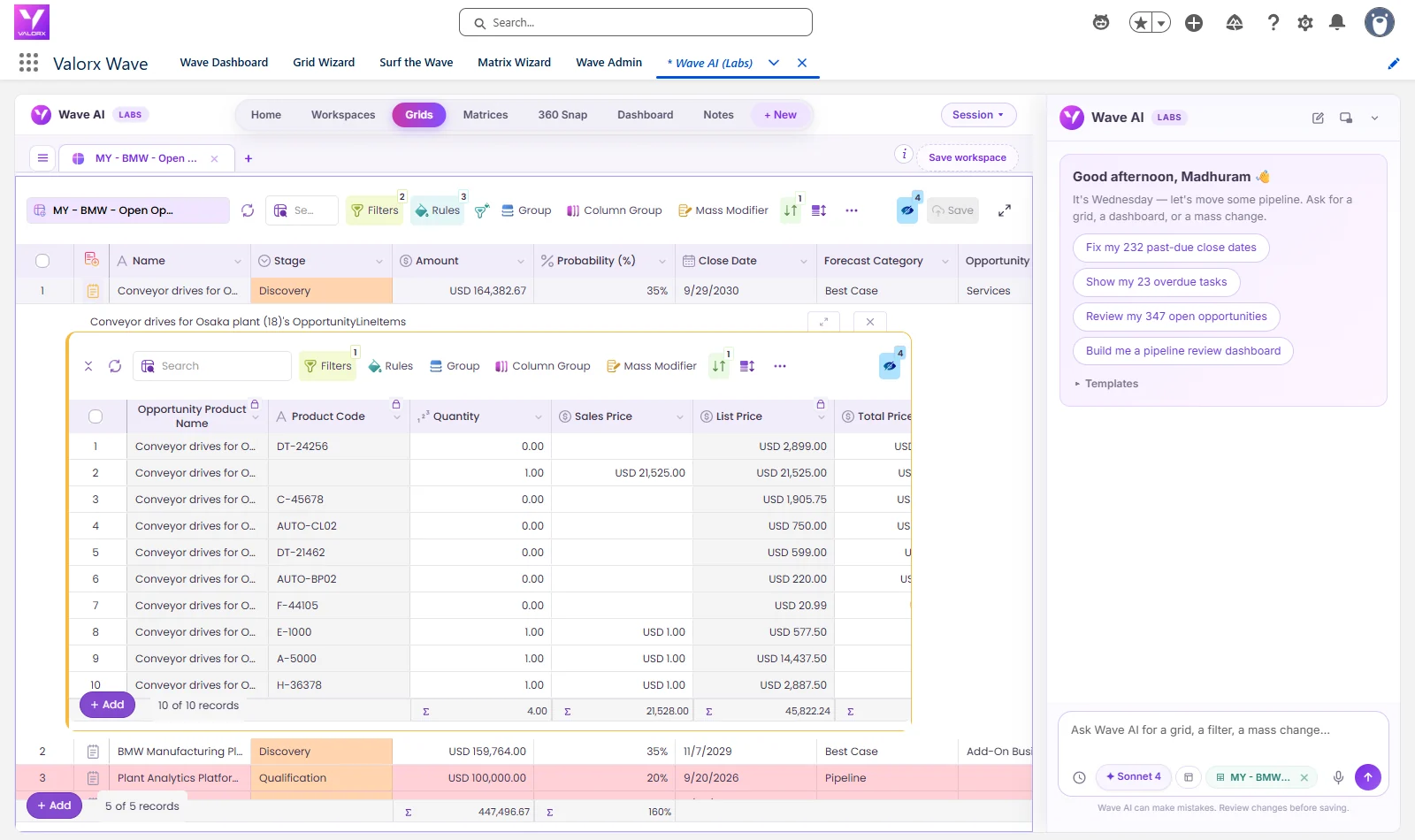
- Valorx Wave puts a spreadsheet-style grid inside Salesforce for bulk updates to quotes, products and prices.
Both work with any Salesforce object, including Salesforce CPQ and Revenue Cloud. BP uses Fusion on Salesforce CPQ to manage more than 15,000 quotes a year and cut quote cycles from 4 days to 4 hours, and Teladoc Health cut data management time by 70% across three CPQ orgs. Teams that adopt this on CPQ today keep the same way of working when they move to Revenue Cloud.
Frequently asked questions
What is a Salesforce Revenue Cloud partner?
A Salesforce consulting partner that implements Revenue Cloud, including Revenue Cloud Advanced, and migrates customers from Salesforce CPQ. A good one combines Salesforce configuration skills with experience of pricing, quoting, contracts and billing processes.
Is Revenue Cloud Advanced the same as Salesforce CPQ?
No. Salesforce CPQ is a managed package that is now sold only to existing customers. Revenue Cloud Advanced is its successor, built natively on the Salesforce platform with a standard data model, and it can be adopted in modules for pricing, quoting, ordering and billing.
How long does a CPQ to Revenue Cloud Advanced migration take?
Salesforce puts a typical migration at three to six months from discovery to go-live, with complex implementations taking longer. The biggest variables are how much custom pricing logic you have, how many integrations need rework and how many open quotes and contracts must move.
Do I have to migrate from Salesforce CPQ now?
No. Salesforce has not announced an end-of-life date for CPQ, and existing customers can renew, add licenses and receive support. Many teams extend CPQ while they plan a migration on their own timeline.
What should I ask a Revenue Cloud partner?
Ask how many CPQ to Revenue Cloud Advanced migrations they have delivered, for references in your industry, how they migrate active quotes and contracts, which integrations will need rework, how they test pricing logic, and what support looks like after go-live.
Does Valorx work with Revenue Cloud?
Yes. Valorx Fusion and Valorx Wave work with any Salesforce object, including Salesforce CPQ and Revenue Cloud, so teams can use the same spreadsheet-style quote editing before and after a migration.





Choose the workflow you need:
Try Wave in browser Extension

Try Wave in Salesforce

Try Fusion In Excel

Enhancing Salesforce for industry leaders