CPQ statistics 2026: market size, adoption and quoting benchmarks

The CPQ software market was worth about $3.2 billion in 2025 and is forecast to reach about $8.9 billion by 2032. Manufacturing is the largest buyer, sellers spend only 40% of their time selling, and 67% of B2B buyers would rather skip the rep. For a team running Salesforce CPQ, those numbers point the same way: quoting has to get faster and cleaner, and the tools around it have to be connected.
We built this page for the people who own quoting day to day, such as RevOps, sales operations and CPQ admins. Every figure has a named source and date, and after each one we explain what it means for your team and your business case.
Key takeaways
- CPQ spend is growing about 16% a year, so leadership expects quoting to be a solved problem, not a bottleneck.
- Manufacturing accounts for over 31% of CPQ revenue, because configurable products and volatile prices make quotes hard.
- Sellers spend 40% of their time selling. Slow quoting eats into the rest.
- 67% of B2B buyers prefer a rep-free experience, so the quotes you do send must be fast and right the first time.
- Deloitte research cited by Salesforce links 13% of lost deals to disconnected tools.
- Salesforce CPQ is in end of sale. Existing customers can keep using it, but the next platform decision is coming.
CPQ statistics at a glance
| Statistic | Figure | Source |
|---|---|---|
| CPQ software market size, 2025 | About $3.2 billion | Persistence Market Research |
| CPQ market forecast, 2032 | About $8.9 billion (15.7% a year) | Persistence Market Research |
| Manufacturing share of CPQ revenue, 2025 | Over 31%, the largest industry | Persistence Market Research |
| Cloud share of CPQ deployments, 2025 | About 59% | Persistence Market Research |
| Share of time sellers spend selling | 40% | Salesforce |
| Sales organizations using AI | 87% | Salesforce |
| Sales leaders whose AI is slowed by disconnected systems | 51% | Salesforce |
| B2B buyers who prefer a rep-free experience | 67% | Gartner |
| Deals lost because of disconnected tools | 13% (Deloitte, cited by Salesforce) | Salesforce |
| Salesforce CPQ status | End of sale since March 2025, no end-of-life date | Salesforce |
Swipe the table to see all columns
New to the category? Start with what CPQ is and how it works.
The CPQ market is growing fast

Persistence Market Research estimates the CPQ software market at about $3.2 billion in 2025, rising to about $8.9 billion by 2032, or 15.7% a year. Technavio via Research and Markets is even more bullish, forecasting 20.9% annual growth to 2030. The firms define the market differently, but they agree on the direction.
What it means for you: when a category grows this quickly, leadership assumes the problem is solved by buying software. If your team still rebuilds large quotes by hand, that gap is worth measuring and putting in front of the people who sign off on budget.
Manufacturing quotes are the hardest

Manufacturing is the largest end-use industry for CPQ, with more than 31% of revenue in 2025, according to Persistence Market Research. That matches what we see with customers: configurable products, multi-level bills of materials and prices that move with material costs make every quote larger and more fragile.
What it means for you: if you quote engineered or configured products, generic CPQ benchmarks will understate your effort. We cover the specific problems and fixes in CPQ challenges in manufacturing.
Sellers spend less than half their time selling

Salesforce's State of Sales report, based on 4,050 sales professionals surveyed in late 2025, found the average seller spends 40% of their time selling. For Gen Z sellers it is 35%. The rest goes to research, data entry and internal work.
What it means for you: quoting is a big part of that non-selling time on complex deals. Hundreds of quote lines edited one at a time, or copied between Salesforce and a spreadsheet, is exactly the kind of work that shrinks selling time. Our guide to Salesforce CPQ limitations shows where that time goes.
Buyers want speed, not more meetings

Gartner surveyed 646 B2B buyers and found that 67% prefer a rep-free experience, and 45% used AI during a recent purchase. Gartner's own definition of CPQ now includes making configuration and pricing available to self-service channels.
What it means for you: buyers who do talk to a seller expect a correct quote quickly. A revision cycle caused by a pricing error or a stale discount costs more goodwill than it used to.
Disconnected tools cost real deals

Deloitte research cited by Salesforce in its Agentforce for Revenue announcement found that 71% of B2B executives struggle with manual, fragmented sales processes, and that 13% of deals are lost because of disconnected tools. The State of Sales report adds that 51% of sales leaders using AI say disconnected systems are slowing them down.
What it means for you: the spreadsheet your team exports, edits and re-imports is a disconnected tool. The fix is not to ban spreadsheets, which people use because they are fast, but to connect them to live Salesforce data so nothing has to be copied.
AI in quoting depends on clean data
According to the State of Sales report, 87% of sales organizations use some form of AI, and 54% of sellers have used AI agents. Salesforce also reports a 75% reduction in quoting time for its own sales team after using Agentforce for quoting, a vendor-reported figure from its Agentforce for Revenue announcement.
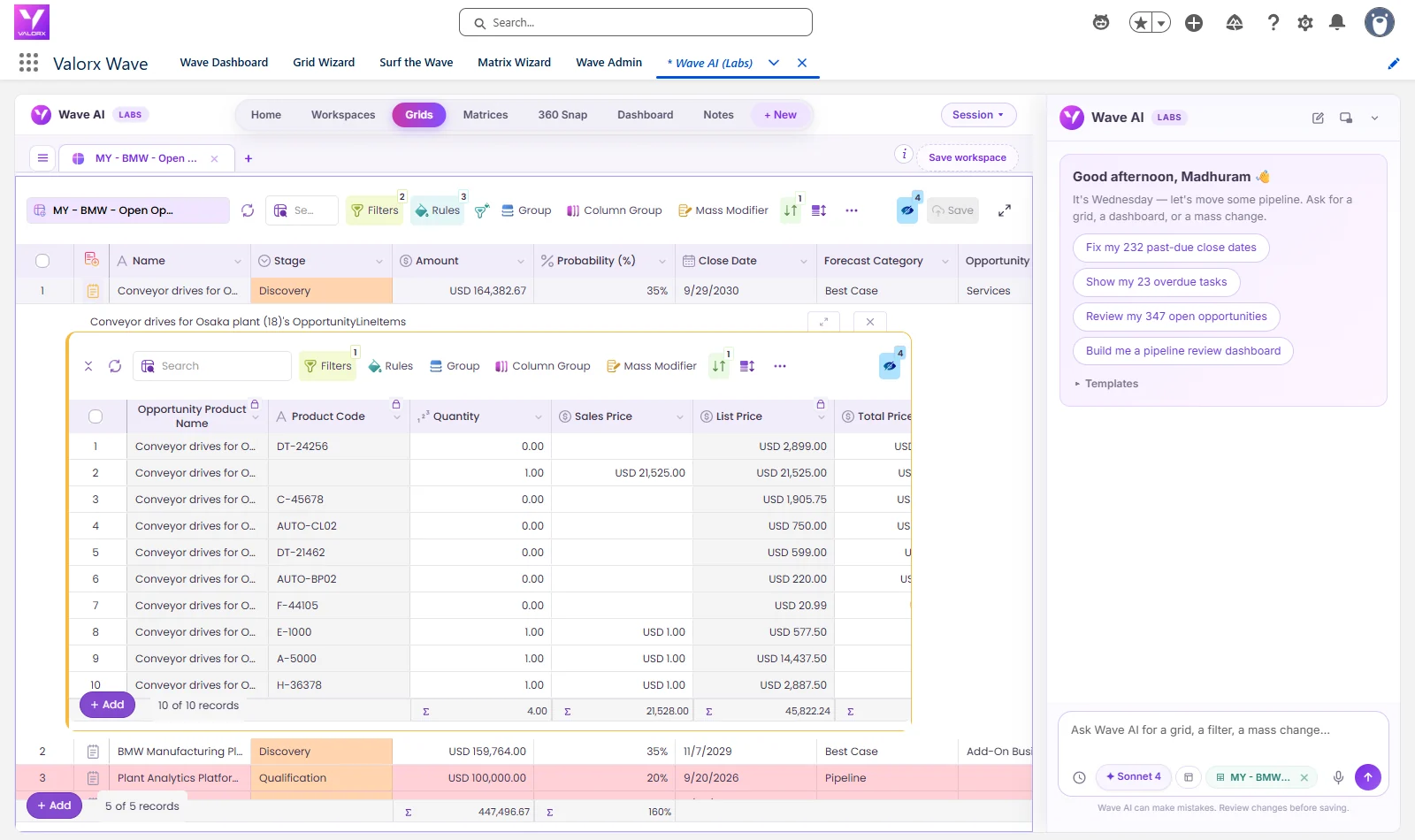
AI agents are only as good as the quote data they work on. That is why we are building Valorx Wave AI, now in private beta. It builds Wave grids inside your Salesforce org from a plain-language request, works alongside Agentforce, and nothing is saved to Salesforce until a person reviews and approves it.
What this means for Salesforce CPQ teams
Salesforce CPQ entered end of sale in March 2025. Existing customers can keep using and renewing it, and Salesforce has not announced an end-of-life date, according to its CPQ end-of-sale page. New customers are offered Revenue Cloud Advanced instead.
For most teams, that means two things. First, the quoting pain behind the statistics above does not go away while you stay on Salesforce CPQ, so it is still worth fixing now. Second, a move to Revenue Cloud is a project in its own right, with data migration, retraining and new pricing logic. Our Q&A on whether Salesforce CPQ is still worth it in 2026 covers the decision, and our guide to choosing a Salesforce Revenue Cloud partner covers what a migration involves.
Where Valorx fits
Valorx does not replace your CPQ. We make the quote editing inside it faster, on Salesforce CPQ today and on Revenue Cloud if you move.

Across Fusion customers, teams save an average of 20% of the time they spend on complex quotes in Salesforce CPQ. This figure comes from our own customer data, not an independent study.
- Valorx Fusion connects Excel and Google Sheets to live Salesforce data, so reps edit full quotes with formulas, filters and bulk changes, then save back with Salesforce rules applied.
- Valorx Wave puts a spreadsheet-style grid inside Salesforce for bulk updates to quotes, products and prices, for teams that do not want to leave Salesforce.
Both work on the same Salesforce objects before and after a migration, so the way your team quotes does not have to change when the platform does. Here is what that has looked like for customers.
| Customer | Before | After |
|---|---|---|
| BP | 4-day quote cycles, 40% of quoting work in disconnected spreadsheets | 4-hour quote cycles across more than 15,000 quotes a year |
| Genpact | Salesforce CPQ pilot stalled at 100 licenses | 600 users, quotes built 3x faster, 750,000 hours saved a year |
| Teladoc Health | Manual exports and re-entry across three CPQ orgs | 70% less data management time, zero re-entry errors |
Swipe the table to see all columns
How to use these statistics in your business case
Market numbers make the case that quoting matters. Your own numbers make the case for a specific fix. Before you build a business case, measure four things: quotes per month, average lines per quote, hours per quote and how often quotes are revised. Then compare them with the results above. The CPQ ROI calculator turns those inputs into an estimate of time and cost saved.
We only include figures with a named source and a date. Several widely shared CPQ statistics, such as claims about quote times or win rates from surveys between 2013 and 2016, are left out because their original sources are no longer available or are too old to reflect current tools.
Frequently asked questions
How big is the CPQ software market?
Persistence Market Research puts the CPQ software market at about $3.2 billion in 2025, growing to about $8.9 billion by 2032 at 15.7% a year. Technavio forecasts $5.46 billion of growth between 2025 and 2030 at 20.9% a year. Estimates differ by firm because each defines the market differently.
Which industry uses CPQ the most?
Manufacturing. Persistence Market Research estimates that manufacturing accounts for more than 31% of CPQ software revenue in 2025, the largest share of any end-use industry, because manufacturers quote configurable products, deep bills of materials and volatile pricing.
How much time do sales reps spend selling?
According to Salesforce's State of Sales report, published in February 2026 from a survey of more than 4,000 sales professionals, the average seller spends 40% of their time selling. The rest goes to tasks such as prospecting research, data entry and internal work.
Is Salesforce CPQ being discontinued?
Salesforce CPQ entered end of sale in March 2025, so it is no longer sold to new customers, who are offered Revenue Cloud Advanced instead. Existing customers can keep using and renewing it, and Salesforce has not announced an end-of-life date.
What is Valorx Wave AI?
Valorx Wave AI, now in private beta, builds Wave grids inside your Salesforce org from a plain-language request. It works alongside Agentforce, and nothing is saved to Salesforce until a person reviews and approves it.
Why are some older CPQ statistics not included?
Many widely shared CPQ statistics trace back to surveys from 2013 to 2016 or to blog posts without a primary source. We only include figures with a named source and date, and we label vendor-reported numbers as such.
How can I estimate CPQ ROI for my team?
Start with your own baseline: quotes per month, lines per quote, hours per quote and revision rates. Then apply realistic improvements from comparable teams. Our CPQ ROI calculator does this with your numbers.
Sources
- Persistence Market Research, CPQ Software Market report, 2025
- Technavio via Research and Markets, CPQ Software Market 2026-2030, February 2026
- Salesforce, State of Sales report announcement, February 2026
- Gartner, press release on B2B buyer survey, March 2026
- Salesforce, Agentforce for Revenue announcement, July 2025
- Gartner Magic Quadrant for CPQ Applications, market definition
- Salesforce, CPQ end-of-sale page





Choose the workflow you need:
Try Wave in browser Extension

Try Wave in Salesforce

Try Fusion In Excel

Enhancing Salesforce for industry leaders