We Searched 390,000 Words of Dreamforce for "Update the Record"
Dreamforce
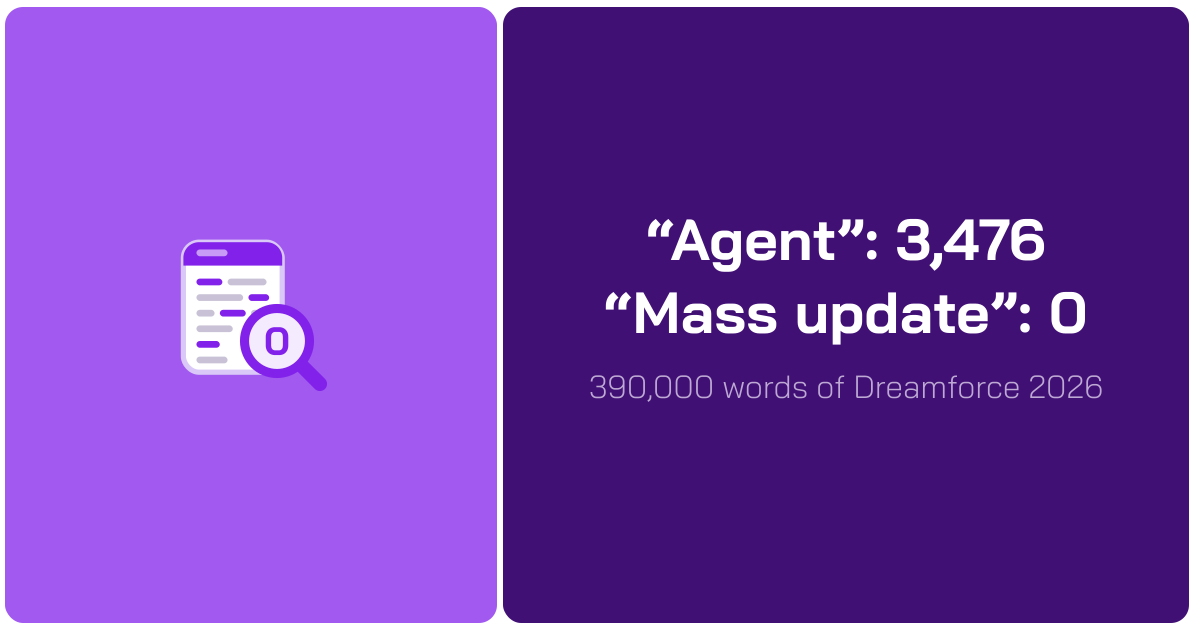
The short answer. Across 86 Dreamforce 2026 sessions and 390,631 words of transcript, the word "agent" appears 3,476 times, "governance" 263 times, and "data quality" 48 times. The phrases "update the record," "mass update," "bulk update" and "fix the record" appear zero times. In the sessions we analyzed, the conversation overwhelmingly focused on how agents decide—not on how records get corrected at scale.
We downloaded the captions for 86 Dreamforce 2026 sessions, which came to 91 files and 390,631 words. They included keynotes, roadmaps, the admin track, Data 360, Tableau, and the partner sessions nobody posts about. Then we did something unfair and, we think, revealing. We counted words.
Zero. Not rare. Not deprioritized.
This was an entire conference about making your CRM intelligent, and nobody on any stage we captured said the words "mass update," "bulk update" or "update the record."
What this is not evidence of
A word count proves less than it looks like it does, so we want to be fair about that before making an argument.
It does not prove Salesforce cannot update records. Obviously it can, since it is a database with an API. It does not prove anyone thinks record correction is unimportant. Our corpus is also 86 sessions out of roughly 1,600, so it is a sample, and it is weighted toward keynotes and the tracks most relevant to admins and data teams.
What a word count does show is where attention went. Attention is the scarcest thing at a conference, because a product team had to fight for every minute on that stage.
Where the attention actually went
Dreamforce was about deciding what should happen next. The dominant story was decision-making.
- How does an agent reason?
- What context does it receive?
- What actions should it be allowed to take?
- How do you observe it?
- How do you govern it?
- How do you know whether its answer can be trusted?
Those are legitimate and difficult problems. Much of what Salesforce showed at Dreamforce was aimed directly at them.
The Tableau keynote produced the line we keep coming back to. A Mastercard speaker was describing why their dashboards went unused:
And if you guys are sitting on a rich CRM and BI data and your dashboard adoption is low, you have the same exact problem as we did. The data is not the bottleneck, the interface is.
Source: Tableau Keynote: Beyond BI, Welcome to Agentic Analytics
That is exactly right, and we would push it one step further. The interface for looking at data got a great deal better this year. The interface for changing data did not get mentioned.
The one write-back that was demonstrated
We went looking for counter-evidence, and there is a genuine write-back demo in the headless analytics session. Someone gives a chat answer a thumbs down, and an agent proposes an improvement. A data steward reviews it side by side and approves it, and the change writes back.
What it writes back is the description of a data source and the definition of a calculated field. That is metadata, not a record. The session also noted that the API behind it was still about a month from release and not yet integrated with MCP.
That is a good feature, and we are glad it exists. It is not somebody fixing four hundred opportunities.
The counterexample: Agentforce Grid
This is where the analysis needs nuance.
Salesforce does have a spreadsheet-style product for working across records. Agentforce Grid combines CRM data, prompts, actions and agents in one grid. It can update records in bulk, and Salesforce's own guidance on mass-updating records lists it as one of the available approaches.
So the takeaway from our transcript search is not that Salesforce forgot bulk editing. It is that bulk record correction got remarkably little airtime next to the AI systems that increasingly depend on clean, reliable records.
That distinction matters. The capability exists. The attention is somewhere else.
Why record correction gets less attention
We do not think this is an oversight. Bulk record correction is hard to turn into a keynote moment.
An agent working through a complex problem has a narrative arc: it understood, it decided, it acted. A grid of records becoming accurate does not. It looks like a spreadsheet, and often that is exactly what it should look like. It is also nobody's new product. It is the thing that has to happen before the new product works.
The Agentforce operations session came closest to naming the underlying problem:
They're inconsistent because people have to constantly rekey data, send spreadsheets back and forth, duplicate spreadsheets so suddenly you have three different versions of the truth.
Source: Three Steps From Manual Processes to AI-Driven Operations
That is a precise diagnosis. An agent can keep some of those processes from running manually in the future. But companies also have the data they already have today:
- stale opportunities
- incomplete accounts
- incorrect owners
- missing next steps
- duplicate values
- records that break automation
Before intelligence can operate on those records, someone or something has to correct them.
AI makes the boring data work more important, not less
The admin track was blunt about it:
so when we're thinking about the reality of data quality in a new agentic world the reality is there's no workaround to poor data quality you either have to work to clean it or you have to work to clean up the consequences of it
Source: Prepare Your Data for Agentforce: Governance and Quality
In an agentic system, that matters more. Bad CRM data used to produce a bad report. Now it can produce a bad decision, and that decision can trigger an action.
So an AI roadmap needs more than models, agents, prompts, governance and observability. It also needs an answer to an ordinary question: when we find hundreds of records that need correcting, how quickly can someone fix them safely?
Detection is half the workflow. Correction is the other half.
The practical consequence for your Agentforce roadmap
If you are planning an Agentforce rollout, do not stop your data quality plan at these three steps:
- Identify the bad data.
- Classify the problem.
- Assign a quality score.
Add a fourth step: decide how the records will actually get corrected.
Depending on the problem, the answer might be automation, Agentforce Grid, Flow, Data Loader, the API, a list view or a purpose-built tool. What matters is that the correction workflow is designed on purpose, not left to whoever receives the spreadsheet afterward.
The handoff between "we found the problem" and "the CRM is now correct" is still where a surprising amount of enterprise work lives. It is still measured in days.
Where Valorx Wave fits
Our perspective here is not neutral, since we build one of those correction tools.
Valorx Wave is built for the human-operated side of the problem. It puts Salesforce records in an editable grid inside Salesforce. You filter to the records that need attention, edit cells directly, then copy, paste and fill down across rows. Changes are staged with the old value beside the new one, saved together, and undoable.
Wave AI moves one step earlier. You ask a question in plain English, and it finds the records behind the answer and opens them in a grid where the team can act.
That does not make Wave the only answer to bulk record correction. Salesforce itself provides several. Our point is simpler: finding bad data and fixing bad data are two different jobs. The first is becoming dramatically more intelligent. The second still needs to be fast, reviewable and safe, and for many Salesforce teams it still looks a lot like a spreadsheet.
The question we came away with
The interesting question after Dreamforce is not whether AI can update a Salesforce record. It can.
The more useful question is what happens when AI finds four hundred records that need a human decision before they are changed.
That is the space between intelligence and execution. It may not make the keynote, but it is still where a lot of the work happens.
Method notes
- The sample is 86 sessions out of roughly 1,600, weighted toward keynotes and the platform, admin, data and analytics tracks.
- Machine captions mishear product names and drop words, so treat the counts as indicative. The direction of the finding is robust, but the precise numbers are not.
- A word count measures attention, not capability.
Frequently asked questions
What were the main themes of Dreamforce 2026?
The main themes were agents and how they reason, act and are governed. Across 86 session transcripts, the word "agent" appears 3,476 times and "governance" 263 times. "Data quality" appears 48 times.
Did Dreamforce 2026 address bulk record editing?
Rarely in the sessions we captured. The phrases "mass update," "bulk update," "update the record" and "fix the record" appear zero times across 390,631 words of transcript.
Can Agentforce update Salesforce records?
Yes. Agents can take actions on records through defined, governed actions, and Agentforce Grid supports bulk record updates in a spreadsheet-style interface. This analysis is about conference attention, not product capability. The sessions focused on how agents decide rather than on correcting existing records at volume.
How was this analysis done?
We collected captions for 86 Salesforce+ sessions into 91 transcript files totaling 390,631 words, then searched them for exact phrases. Machine captions contain transcription errors, so the counts are indicative rather than exact.
Sources
Every quote above is verbatim from the session captions and links to the Salesforce+ recording. The captions carry no speaker labels, so quotes are attributed to the session rather than to an individual.
- Tableau Keynote: Beyond BI, Welcome to Agentic Analytics, Dreamforce 2026, Salesforce+
- Three Steps From Manual Processes to AI-Driven Operations, Dreamforce 2026, Salesforce+
- Prepare Your Data for Agentforce: Governance and Quality, Dreamforce 2026, Salesforce+
- Mass update records in Salesforce, Salesforce Help
Choose the workflow you need:
Try Wave in browser Extension

Try Wave in Salesforce

Try Fusion In Excel

Enhancing Salesforce for industry leaders