Three Different Versions of the Truth
The short answer: Manual processes break because people rekey data and pass spreadsheets around until several versions of the truth exist and Salesforce stops being the single source of truth. Dreamforce 2026 diagnosed this precisely and answered it with agents that run processes end to end. That helps future work. It does not reconcile the duplicate spreadsheets and inconsistent records an organization already has.
One session at Dreamforce 2026 gave the most accurate description of enterprise dysfunction we have heard from a vendor stage. It was not a keynote. It was a product marketing session on moving manual processes to AI-driven operations.
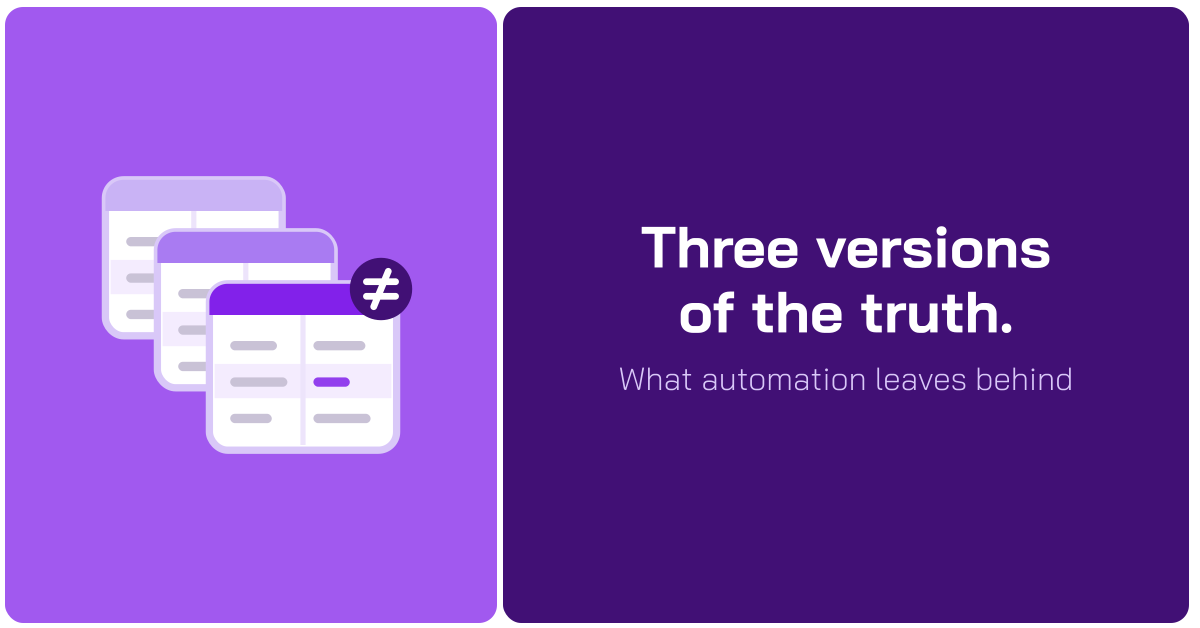
They're slow and inefficient because they operate at human speed, however long it takes somebody to send an email, file, fill out a portal, send it back to someone else. They're inconsistent because people have to constantly rekey data, send spreadsheets back and forth, duplicate spreadsheets so suddenly you have three different versions of the truth. They're also invisible because they span people and systems and processes and there's no way to actually see what's going on.
Source: Three Steps From Manual Processes to AI-Driven Operations, Dreamforce 2026
Slow, inconsistent, invisible. And the number attached to it in the same session: 60 to 80 percent of processes are manual.
If you work in revenue operations, you did not need to be told any of this. What is useful is hearing it said on a Salesforce stage, because it settles an argument that usually goes the other way.
The argument it settles
When someone points out that a team runs its forecast in a spreadsheet, the reflex is to treat it as a discipline problem. People are not using the system properly. More training, more validation rules, a stern email.
That session describes it correctly instead: as a design outcome. People rekey data because the process makes them. They duplicate spreadsheets because passing a file is the only way to hand work to someone. Nobody woke up wanting three versions of the truth. Everyone would rather Salesforce were the single source of truth. The process just does not let it be.
The answer offered
The proposed answer was agents that run the process end to end, with humans brought in where judgment matters. The same session was refreshingly blunt about the two alternatives, consulting-led transformation and frontier models, and gave a reason for the second that is worth quoting:
Your IP is likely training their model. They're non-deterministic, and they don't know how your business works. They don't know that you need to follow these steps every time for this process. A person always needs to sign off on certain steps of them.
Source: Three Steps From Manual Processes to AI-Driven Operations, Dreamforce 2026
A speaker from a mining company in the same session put the operational version more memorably: "Pretty close is not good enough when you're processing invoice reconciliations."
All of that is a good answer for a process you are about to redesign. Our objection is narrower and, we think, harder.
The three versions you already have
Automating a process going forward does nothing about the state it left behind. The duplicate spreadsheets exist. The rekeyed values are sitting in fields right now, slightly different from each other, and the reconciliation everyone keeps postponing is the same size it was on Monday.
Very little shown on stage this year was about picking up that backlog. The tooling that got better is the tooling for knowing about it: profiling, scoring, cataloging, flagging. That is real progress, and it ends with a list.
This was the pattern across the whole conference. Excellent work on knowing. Very little on fixing.
Why the spreadsheet keeps winning
A spreadsheet beats a CRM for this work not because of features. It wins on four small things, and they compound:
- You can type into any cell without opening anything.
- You can fill a value down two hundred rows.
- You can paste a column.
- You can see everything you changed before you commit to it.
That is the entire advantage, and it is enough to defeat any amount of governance. Until those four things are the default way people work with records, people will keep exporting, Salesforce will not be the single source of truth, and the third version will keep being created by someone acting reasonably.
Another session made the same point from the analytics side, arguing that low dashboard adoption is not a data problem: "The data is not the bottleneck, the interface is." Same observation, one system over.
What we would do about the backlog
Where Valorx Wave fits
Disclosure: this is the problem our product exists for, so weigh this section accordingly.
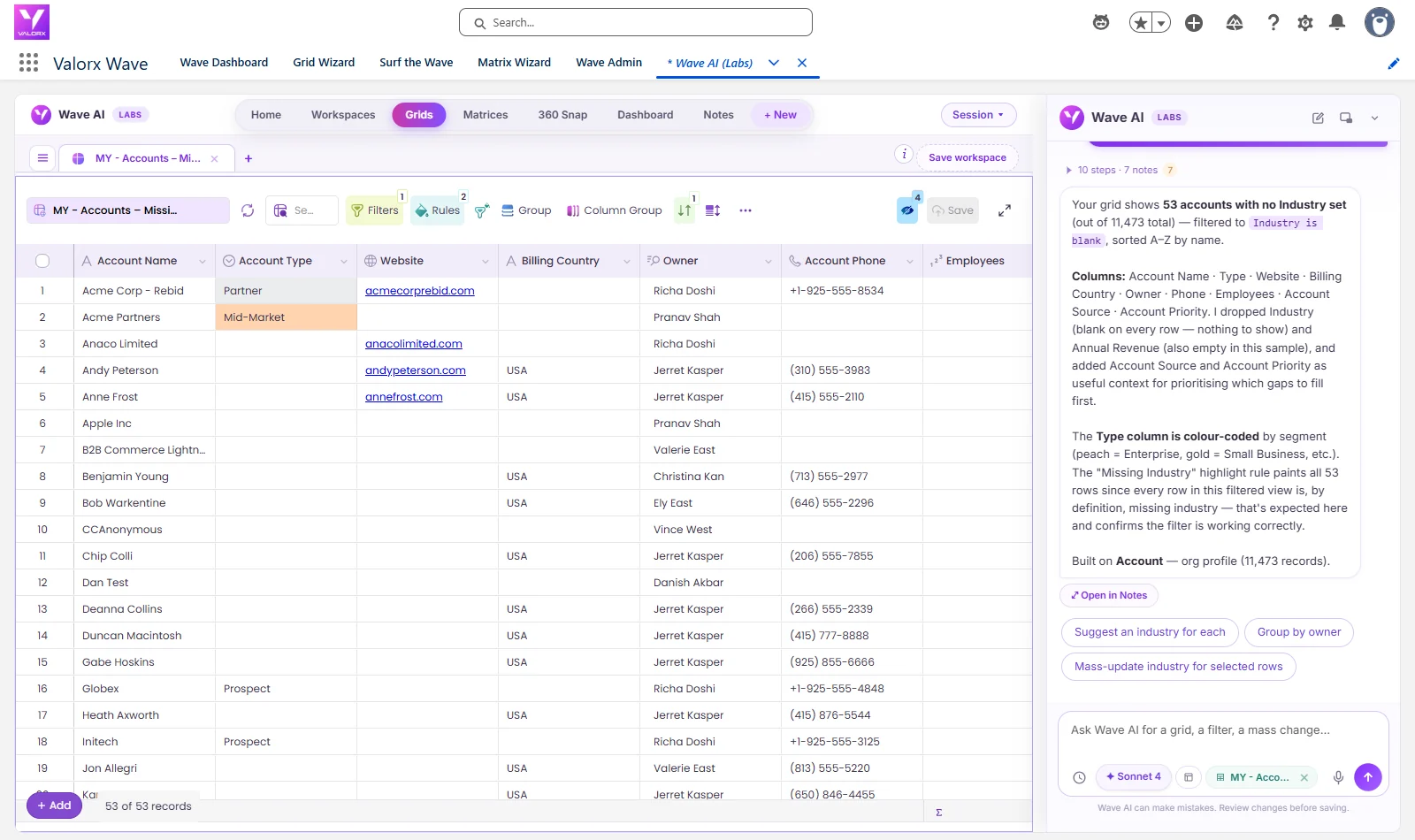
Valorx Wave gives Salesforce those four spreadsheet properties, on the real records, inside the org. Type into a cell, fill down, paste a column, and see every change, old value beside new, before it saves. Wave AI, now in private beta, handles step one: ask for the records that need attention in plain English, and it opens them in that grid.
That is not a grand vision of the agentic enterprise. It is the thing that has to be true before Salesforce can be the single source of truth the agentic enterprise assumes.
Frequently asked questions
Why isn't Salesforce our single source of truth?
Because the work happens outside it. When updating records at volume is easier in a spreadsheet, people export, edit and rekey, and every copy becomes another version of the truth. Salesforce becomes the single source of truth only when fixing records in it is as fast as fixing them in a spreadsheet.
Why do teams use spreadsheets instead of the CRM?
Because spreadsheets allow four things most CRM screens do not: typing into any cell, filling a value down many rows, pasting a column, and reviewing every change before committing. Those four beat any amount of governance.
What percentage of business processes are manual?
A Dreamforce 2026 session on AI-driven operations put it at 60 to 80 percent of processes. No source for the figure was given on stage.
Does automating a process fix existing bad data?
No. Process automation changes how future work is done. Records already carrying rekeyed or inconsistent values stay as they are until something corrects them.
Sources
Quotes are verbatim from the session captions, with punctuation added for readability, and link to the Salesforce+ recordings. The captions carry no speaker labels, so quotes are attributed to the session rather than to an individual.
- Three Steps From Manual Processes to AI-Driven Operations, Dreamforce 2026, Salesforce+
- Tableau Keynote: Beyond BI, Welcome to Agentic Analytics, Dreamforce 2026, Salesforce+
.svg)




Choose the workflow you need:
Try Wave in browser Extension

Try Wave in Salesforce

Try Fusion In Excel

Enhancing Salesforce for industry leaders