Humans Ask, Agents Assume: What Dreamforce 2026 Didn't Say About Salesforce Data Quality
.svg)
Dreamforce
Quick answer: Dreamforce 2026 was consistent on one point: Salesforce data quality now decides whether AI agents work, because unlike a person, an agent won't pause to question a value that looks wrong. The tools announced to address this mostly profile, score, catalog and govern data. Correcting the values on existing records is still left to a person working on a cadence.
Our team attended a lot of Dreamforce this year. Then we did something less pleasant: we went back through the recordings of 86 sessions. Keynotes, roadmaps, the admin track, Data 360, Tableau, and the sessions nobody posts about.
One line has stayed with us. It comes from the admin track session on preparing data for Agentforce, and it's the most useful thing anyone said all week.
Humans ask, agents assume. If you're standing next to someone and they're showing you a report and something doesn't look right, you're gonna ask a question. An agent is just gonna act. They don't know to doubt what you're giving them.
Source: Prepare Your Data for Agentforce: Governance and Quality
That's the whole problem in three sentences, and it reframes a decade of arguments about data quality. We used to treat bad data as a reporting problem. A wrong industry value made a segment slightly off. Someone noticed eventually, or didn't, and life went on.
An agent doesn't have the thing that saved us: a person looking at a screen and thinking, that's not right.
Why poor Salesforce data quality breaks AI agents
The same session put it more sharply:
so when we're thinking about the reality of data quality in a new agentic world the reality is there's no workaround to poor data quality you either have to work to clean it or you have to work to clean up the consequences of it
Source: Prepare Your Data for Agentforce: Governance and Quality
It also named why this happens even in well-run orgs, which deserves to be quoted more often than it is:
They all know pick list values or required fields that they don't actually have the information to, but it's required, so they just put something in it so they can click save. Humans have adapted to that, but agents don't have that same adaptation.
Source: Prepare Your Data for Agentforce: Governance and Quality
Every admin reading this just recognized their own org. The required field someone fills with a period. The picklist where half the team picks Other. None of it was malicious, and all of it was rational, because the alternative was not being able to save the record.
Who was actually speaking
This matters, so we want to be precise. The admin track sessions quoted here were delivered by community MVPs and partner consultants, not Salesforce employees. One speaker says plainly during his session that he doesn't work for Salesforce.
So this isn't "Salesforce admits." It's more interesting than that: the people who implement this for a living, on a Salesforce stage, describing what they run into.
What Dreamforce 2026 announced for data quality
Across those sessions, a lot of capability was announced and demonstrated. Here's what each one does, in the speakers' own terms.
| What was shown | What it does to your data |
|---|---|
| Identity resolution in Data 360 | Stitches records to a unified ID above them |
| Profiling tools | Reports which fields are stale, unused or single-valued |
| Data dictionary and semantic layer | Grounds agents in what fields mean |
| AI readiness scoring | Scores the estate, names the gaps, suggests fixes |
| Enrichment vendors | Overwrites firmographic fields from an external source |
| Archiving | Moves data out of the org so it can't mislead |
| Duplicate and validation rules | Stops new bad data at entry |
Read that second column again. Profile, score, catalog, stitch, ground, govern, archive, prevent. All genuinely useful, and several overdue.
Only one of them changes values on existing records, and enrichment only reaches the fields an outside vendor knows about: industry, headcount, revenue. It can't tell you the next step on an opportunity, the right stage, or what belongs in the field someone filled with a period. Those values are only known inside your company, and nothing on the list corrects them.
Does identity resolution fix duplicate records?
The Data 360 admin session covered identity resolution, including this, about two records that might be the same person:
This is why you would implement identity resolution and data 360 that would tell you if both of these records have the same unified individual ID or not because that is going to stitch them together. If not, they are still separate records.
Source: Build Trusted Data for Agentforce with Data 360
"If not, they are still separate records." That's an honest, accurate description of what identity resolution does, and it's exactly the boundary we're pointing at. A unified ID sits above your records. The records underneath are unchanged.
The same session went further, advising that some bad values shouldn't be used in matching logic at all. That's the right advice for matching. It's also an admission that the value stays wrong.
So who fixes the records?
The answer given, repeatedly and sincerely: a person, on a cadence, with discipline.
Review your duplicate matching rules. If you've got any of the third-party apps that do duplicate support, make sure that you're running it on a regular cadence, actively monitoring how data is coming into your system.
Source: Prepare Your Data for Agentforce: Governance and Quality
The same session called these "admin 101 things" that fall through the cracks when people move fast. True, and also the entire problem. They fall through the cracks because doing them is slow, and nothing announced this year made doing them faster.
The Data 360 session was blunter, from someone who leads data governance on one of the oldest production orgs there is:
And the things we do, it really requires discipline, is that we making sure that cleanup is part of our data governance operations. And I'm going to insist on that. It's actually not something that organizations prioritize, but it's very, very important.
Source: Build Trusted Data for Agentforce with Data 360
We'd put it differently. Organizations don't skip cleanup because they undervalue it. They skip it because it costs a day, every time, and the day never fits.
The gap: cost per fix, not discipline
Dreamforce 2026 made an excellent case that record quality is now the constraint on AI working at all. It shipped serious tooling for knowing what's wrong.
What it didn't address is the part between knowing and fixed. That isn't a technology gap. It's an ergonomics gap. Finding 400 opportunities with no next step is a query. Fixing them is 400 record pages, or an export and a Data Loader round trip, or a flow someone has to write and test.
That's why cleanup falls through the cracks. Not discipline. Cost per fix.
Where Valorx Wave fits
This is what we built Valorx Wave for, so read this section knowing that.
We make the fixing cheap. The records your profiling tool flagged open in a grid inside Salesforce, in columns you can type into. Fill down, paste a column, sort so the blanks group together, and change 400 rows the way you would in a spreadsheet. Every change is staged, shown with the old value beside the new, saved together, and can be undone.
With Wave AI, you don't even build the grid. Ask for "opportunities closing this quarter with no next step" and it builds the view. You make the fixes, you approve, and it saves inside Salesforce. Nothing writes without your approval.
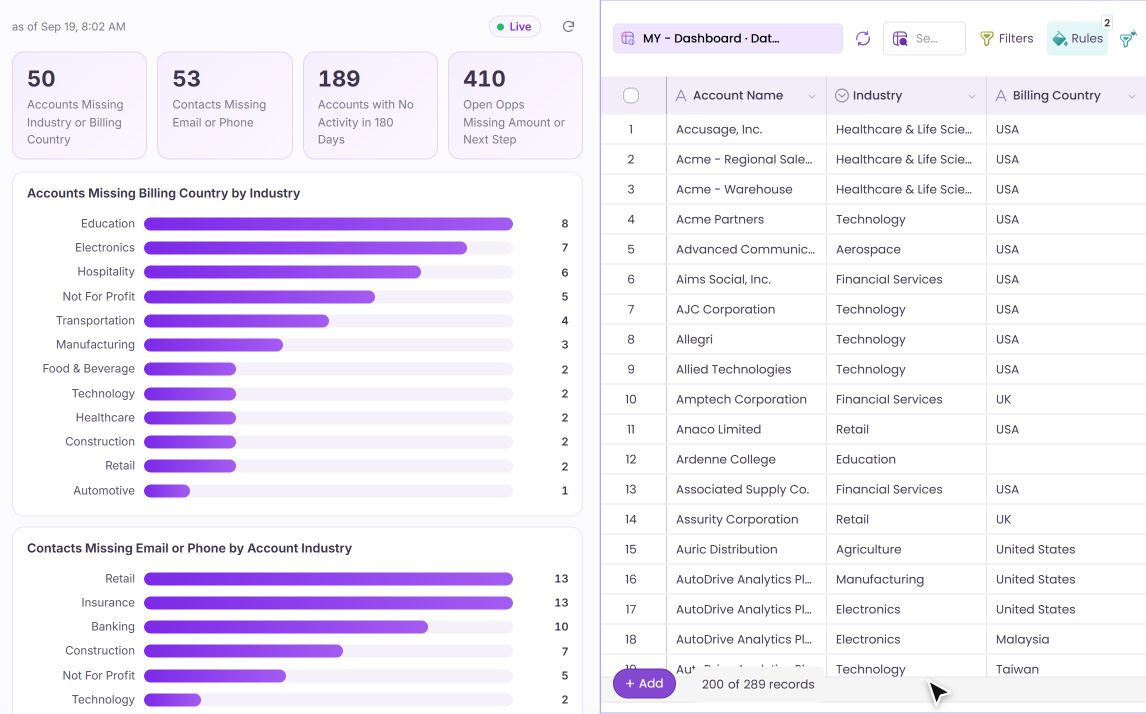
None of this competes with what Salesforce announced. Profiling still tells you what's broken. Identity resolution still stitches. Enrichment still fills firmographics. Wave is the step after all of them: the one where someone actually corrects the records, at volume, without leaving the org.
If the answer to "who fixes it" is still a person on a cadence, the only question that matters is how long the cadence takes.
How this was researched
- The transcripts behind this post are machine captions with no speaker labels. Quotes are verbatim from the captions and attributed to sessions rather than individuals. Each session is linked so you can check.
- Nothing here says the tooling announced at Dreamforce is bad. It says that tooling addresses a different step than the one this post is about.
Frequently asked questions
What did Dreamforce 2026 say about Salesforce data quality and AI agents?
That data quality is the limiting factor. The admin track framed it as agents lacking the human instinct to question a value that looks wrong, and said there is no workaround to poor data quality.
Does Data 360 fix bad records in Salesforce?
Not in the sense of correcting field values in place. As described at Dreamforce 2026, identity resolution assigns a unified ID across records that match. Records that don't match stay separate, and the values on the underlying records are unchanged.
Do I need to clean Salesforce data before deploying Agentforce?
The sessions argued yes, and pointed to placeholder values in required fields and duplicate records as where agents go wrong. The recommended order is to profile first, so you fix what matters rather than everything.
Who is responsible for fixing bad data in Salesforce?
At Dreamforce 2026, the answer was a person, usually an admin or data governance lead, running cleanup on a regular cadence. The tooling announced helps find problems but leaves the correction step to people.
Are these quotes from Salesforce employees?
Mostly not. The admin track sessions quoted here were delivered by community MVPs and partner consultants. One speaker states during his session that he doesn't work for Salesforce.
How do you fix hundreds of Salesforce records at once?
Open them in an editable grid rather than one record page at a time. Valorx Wave puts the flagged records in a grid inside Salesforce where spreadsheet mechanics work: fill down a column, paste a column, sort the blanks together. Every change is staged and shown with the old value beside the new, saved together, and can be undone, so nothing writes without approval.
Sources
- Prepare Your Data for Agentforce: Governance and Quality, Dreamforce 2026, Salesforce+
- Build Trusted Data for Agentforce with Data 360, Dreamforce 2026, Salesforce+




Choose the workflow you need:
Try Wave in browser Extension

Try Wave in Salesforce

Try Fusion In Excel

Enhancing Salesforce for industry leaders