Salesforce Manufacturing Cloud Adoption: What Successful Implementations Do Differently
Quick answer: Successful Salesforce Manufacturing Cloud adoption looks the same across implementations: leadership treats it as an S&OP process change (not an IT rollout), planners get an editing experience they'll actually use, actuals flow automatically from ERP, and someone owns the platform after go-live. Implementations that skip any of these become shelf-ware within a year — the research-backed patterns are below.
Salesforce Manufacturing Cloud has been generally available since 2019. That is enough time to evaluate more than initial deployments. Manufacturers can now examine what happens one, two, or three years after go-live—and whether the platform becomes part of daily planning or gradually turns into another system that teams update only when required.
Across our work with manufacturing organizations, from mid-market electronics distributors to Fortune 500 semiconductor manufacturers, we have seen a consistent pattern. The technology is often deployed successfully, but sustained Manufacturing Cloud adoption varies widely.
Some organizations use Salesforce Manufacturing Cloud to run monthly sales and operations planning cycles, connect actuals from ERP systems, measure forecast accuracy, and give leadership a trusted view of demand. Others use Salesforce mainly as a record system while planners and Finance continue doing the real work in spreadsheets. A smaller group eventually stops using the platform for its intended planning workflows.
This report examines why those outcomes differ. It explains the Manufacturing Cloud implementation decisions that influence adoption, outlines Salesforce Manufacturing Cloud best practices, and shows how sustained usage affects Manufacturing Cloud ROI.
Methodology note: The findings in this report are based on our direct experience working with manufacturing organizations that are deploying, using, or expanding Salesforce Manufacturing Cloud. Where outcomes are quantified, we use conservative estimates drawn from multiple accounts rather than best-case examples. Company-specific details have been anonymized.
Key Findings
After working with manufacturers deploying Salesforce Manufacturing Cloud, we've observed several consistent patterns that separate successful implementations from unsuccessful ones.
| Finding | Why It Matters |
|---|---|
| Only ~25% of implementations achieve sustained operational use | Adoption—not deployment—is the real challenge. |
| ERP actuals are the strongest predictor of success | Without actuals, forecast accuracy cannot be measured. |
| Finance adoption directly impacts ROI | Parallel spreadsheet processes limit business value. |
| Process design matters more than platform configuration | Successful teams redesign workflows, not just systems. |
| Adoption should be measured beyond go-live | Usage and business outcomes are the true indicators of success. |
What Salesforce manufacturing cloud adoption really means
Manufacturing Cloud adoption is not simply the number of users who can log in or whether the implementation reached its launch date.
The more meaningful measure is whether Salesforce Manufacturing Cloud has become part of the operating process it was purchased to support.
That includes questions such as:
- Do demand planners review and adjust forecasts in the system?
- Are ERP actuals available for comparison?
- Does Finance use the same underlying data?
- Is the monthly S&OP meeting run from Salesforce data?
- Can leadership trust the dashboards?
- Are teams improving forecast accuracy over time?
The gap between technical capability and sustained operational use is the adoption gap.
Manufacturing Cloud implementations are not simply successful or failed. They exist on a spectrum. In our experience, most organizations fall into one of three categories.
Category 1: Sustained operational use
Roughly 25% of the implementations we have observed reach sustained operational use.
In these organizations, Salesforce Manufacturing Cloud supports the monthly S&OP cycle. Demand planners work with the data regularly. Finance uses the same data, either directly in Salesforce or through a connected spreadsheet interface. ERP actuals flow into the platform. Forecast accuracy is measured. Leadership uses dashboards that teams trust.
These organizations generate the strongest Manufacturing Cloud ROI because the platform does more than store information. It supports decisions, reduces manual reconciliation, and creates a measurable feedback loop between forecast and actual performance.
The technology is not fundamentally different in these implementations. The difference comes from decisions made before and during the Manufacturing Cloud implementation.
Category 2: Partial use—Salesforce as the record System, spreadsheets as the working system
Roughly 50% of implementations fall into partial use.
The system is live and technically functional. Sales representatives enter data, reports exist, and leadership may receive dashboards. However, the working forecasting process still happens outside Salesforce.
Planners export information, analyze it in spreadsheets, make adjustments, model scenarios, complete month-end processes, and then upload or re-enter the results. Salesforce remains the system of record, while spreadsheets remain the working system.
This outcome is often treated as a successful Manufacturing Cloud implementation because the software was deployed. However, the organization has not achieved the operating model that justified the investment. It still maintains multiple versions of the forecast, relies on manual reconciliation, and experiences disagreement over which data source should be trusted.
Manufacturing Cloud adoption exists, but it is incomplete. As a result, Manufacturing Cloud ROI is also limited.
Category 3: Shelf-ware
Roughly 25% of implementations we have seen are progressively abandoned.
Usage declines after go-live as interface friction accumulates, data quality deteriorates, and teams return to familiar tools. Within 12 to 18 months, Salesforce Manufacturing Cloud may remain technically active but functionally unused for planning.
In our experience, this outcome is usually predictable during the Manufacturing Cloud implementation design phase. Common warning signs include:
- ERP actuals are deferred without a practical interim process.
- Finance workflows are not included in requirements.
- High-volume planning tasks are expected to happen record by record.
- One generic interface is designed for every persona.
- Adoption is measured only through login activity.
- No senior business leader owns the operating process.
Organizations that identify these risks early can redesign the implementation. Once teams have abandoned the system and rebuilt their old spreadsheet process, recovery becomes much harder.
Manufacturing Cloud Adoption Outcomes
In our experience, implementations typically fall into three outcome categories after go-live.
Salesforce Manufacturing Cloud runs the monthly planning cycle.
Salesforce is the record system, but spreadsheets remain the working system.
The system remains active but is no longer used for planning workflows.
Why Manufacturing cloud implementation decisions shape adoption?
The strongest predictor of Manufacturing Cloud adoption is not the size of the company, the sophistication of its Salesforce team, or the implementation partner’s brand.
It is whether the implementation was designed around the real planning process.
A Manufacturing Cloud implementation affects several connected groups: field sales, demand planning, sales operations, finance, IT, supply chain teams, and executive leadership. Each group interacts with the forecast differently.
When the implementation focuses mainly on object configuration and data model setup, it can overlook the work users must perform every week or month. The system may be technically correct but operationally difficult.
The strongest predictor of Manufacturing Cloud adoption is not technology. It is whether the implementation was designed around the real planning process.
Successful implementations begin with the process and then configure the platform around it. They determine:
- Who creates the forecast
- Who reviews and approves it
- Which data comes from Salesforce
- Which data comes from ERP or other systems
- How actuals are reconciled
- How many records each user must review
- How exceptions are identified
- How Finance performs scenario modelling
- How the final forecast is locked and reported
These decisions establish the foundation for both Manufacturing Cloud adoption and Manufacturing Cloud ROI.
The Manufacturing Cloud Adoption Journey
Successful implementations rarely happen because of platform configuration alone. They follow a predictable path that aligns people, processes, data, and technology around the planning cycle.
Six Salesforce manufacturing cloud best practices for sustained use
Across the strongest implementations we have observed, six practices appear consistently. These Salesforce Manufacturing Cloud best practices are less about configuration and more about operating design.
1. Start with the real planning process, not the platform
Before configuration begins, document the actual monthly forecasting cycle—not the process described in a policy document or the process leadership hopes is happening.
Map:
- Who performs each task
- What system they use
- When they perform it
- What inputs they need
- Where delays occur
- Where data is re-entered
- Where teams disagree about the numbers
The first question should not be, “How should we configure Salesforce Manufacturing Cloud?”
It should be, “What does our current S&OP or forecasting process fail to provide, and how should the new process work?”
This process assessment clarifies whether the platform fits the requirement, which workflows need redesign, and which existing steps should be removed after go-live.
A Manufacturing Cloud implementation that adds Salesforce on top of an unchanged process usually creates duplicate work. A successful implementation replaces unnecessary steps instead of adding another layer.
2. Treat finance as a co-designer
Finance should participate in requirements definition from the beginning.
Its workflows often include:
- Scenario modelling
- Budget comparison
- Actuals reconciliation
- Period close
- Variance analysis
- Approval and lock procedures
- Executive reporting
If those workflows are not designed into Salesforce Manufacturing Cloud, Finance will continue using a separate spreadsheet model. Once that happens, the organization creates two forecast environments: one for operational reporting and one for financial planning.
In many cases, the right solution is not to force Finance to abandon Excel. It is to provide a connected interface that allows Finance to work in a familiar spreadsheet experience while using live Salesforce data as the authoritative source.
This approach supports Manufacturing Cloud adoption without requiring every team to work through the same interface.
3. Include ERP actuals in Phase 1
ERP actuals should be available in Salesforce Manufacturing Cloud at or near go-live.
A full integration may not always be possible in the first phase. However, the implementation should still include a defined interim process for loading actuals on a reliable schedule.
Without actuals, the organization cannot compare forecasted demand with actual performance. Without that comparison, it cannot measure forecast accuracy. Without accuracy measurement, planners receive little evidence that the new process is improving decisions.
The platform then feels like a data-entry obligation rather than a planning system.
We have not seen sustained Manufacturing Cloud adoption without a dependable actuals process. ERP integration is therefore not only a technical workstream. It is a prerequisite for trust and a major driver of Manufacturing Cloud ROI.
4. Design for real data volume
Manufacturing forecasting involves large record volumes.
A planner managing 200 accounts across 12 monthly periods may already be working with 2,400 forecast records before product, channel, region, or scenario dimensions are added.
The Manufacturing Cloud implementation must answer a practical question: how will users review, compare, adjust, and approve that volume of information?
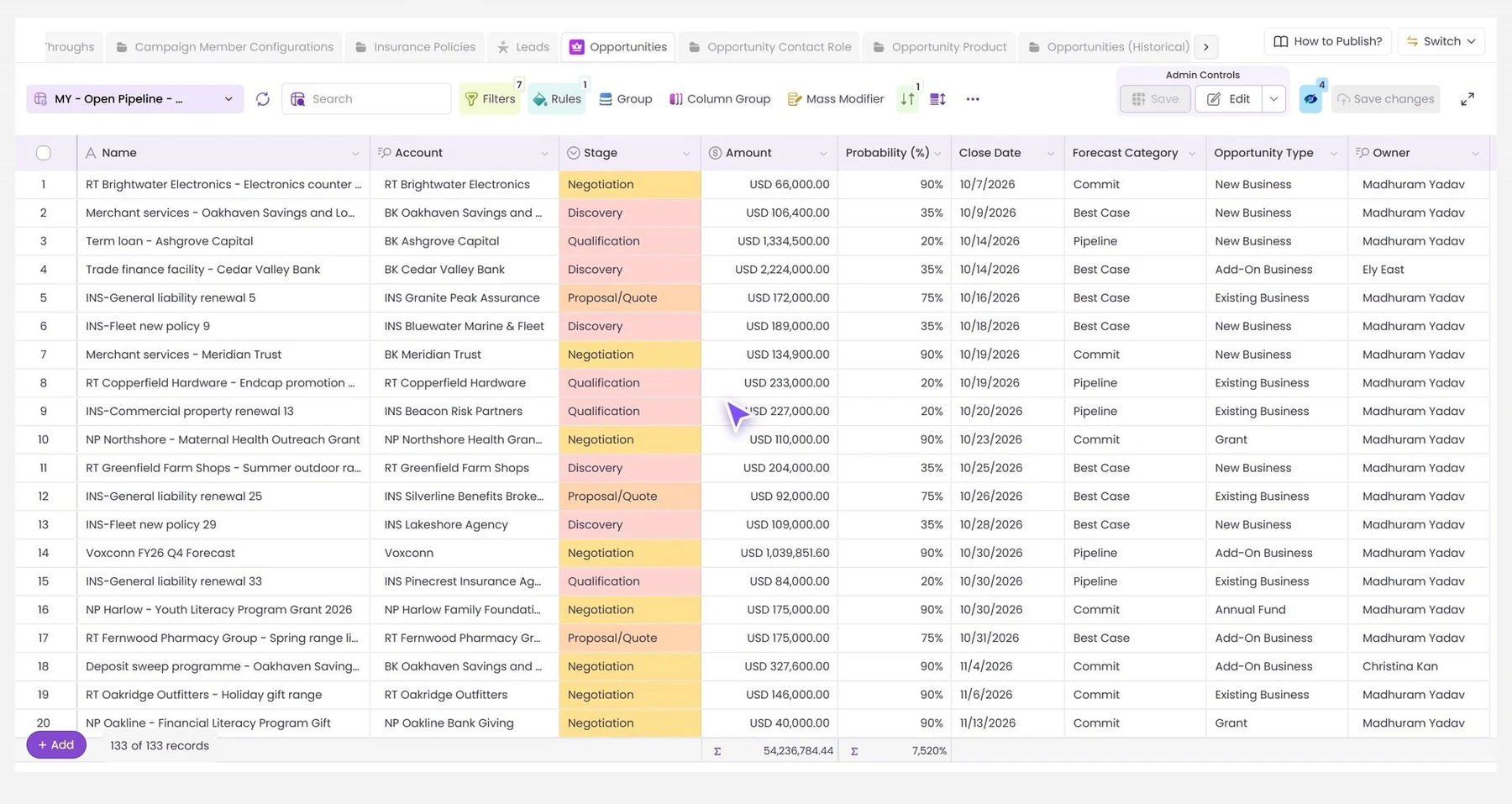
Standard Salesforce navigation is useful for individual records and focused workflows. It is less suited to reviewing thousands of related planning records one by one.
Successful organizations make an explicit design choice. They may:
- Provide a grid-based interface for high-volume updates
- Prioritize exceptions so users do not need to review every record
- Limit the initial scope to accounts with the highest business value
- Automate low-risk adjustments
- Combine these approaches
The mistake is assuming users will adapt to a workflow that is too slow for the volume they manage. They usually respond by exporting the data to spreadsheets, which weakens Manufacturing Cloud adoption and recreates version-control problems.
How NVIDIA handles large forecast volumes
Semiconductor manufacturers often manage thousands of forecast records across products, accounts, and time periods. NVIDIA's forecasting processes required a way to work with large planning datasets while keeping Salesforce data current and accessible.
Read the case study →5. Measure adoption, not just deployment
Go-live is a delivery milestone. It is not proof of business adoption.
A strong Manufacturing Cloud implementation includes usage and process metrics such as:
- The percentage of planners who made forecast adjustments during the latest cycle
- The percentage of active accounts with updated Account Forecast Periods
- The number of forecasts completed outside Salesforce
- The primary data source used by Finance
- The percentage of ERP actuals loaded on time
- The number of manual reconciliation steps
- Forecast accuracy by product, account, or region
- Whether the S&OP meeting was run from Salesforce data
These metrics make adoption erosion visible before the platform becomes shelf-ware.
Login counts alone are not enough. A user may log in to view a dashboard while continuing to perform all working analysis elsewhere. The goal is to measure whether the business process is running through Salesforce Manufacturing Cloud.
6. Assign a senior business owner
Every successful implementation we have observed had a named business owner.
This person was often the VP of Sales Operations, VP of Demand Planning, Head of Commercial Operations, or another leader responsible for planning outcomes.
The business owner:
- Defines the operating process
- Enforces data discipline
- Resolves cross-functional disagreements
- Supports Finance and field adoption
- Prioritizes improvements
- Treats system issues as business risks rather than isolated IT tickets
IT ownership remains essential, but IT should not carry the adoption responsibility alone.
Manufacturing Cloud adoption requires behavioural change across multiple teams. A Salesforce administrator can configure the system correctly, but only business leadership can make it the accepted way of working.
The most common manufacturing cloud adoption killers
The lowest-performing implementations also share a consistent pattern.
The 4 Biggest Manufacturing Cloud Adoption Killers
Most failed implementations can be traced back to one or more of these issues.
No ERP Actuals
Without actuals, forecast accuracy cannot be measured and trust never develops.
Finance Rejection
Finance continues working in spreadsheets, creating multiple versions of the forecast.
UX Friction
High-volume planners hit usability limits and return to spreadsheets.
No Process Redesign
The platform changes, but the underlying planning process stays the same.
No actuals, No accuracy, No trust
Without ERP actuals, Salesforce Manufacturing Cloud cannot show whether the forecast was correct.
That removes the feedback loop that helps planners learn, improve assumptions, and build confidence in the data. The system becomes a place to enter numbers, not a place to understand performance.
When actuals integration is delayed, the Manufacturing Cloud implementation should include a temporary but controlled loading process. Waiting for a future phase without an interim solution creates an immediate value gap.
How Western Digital Improved Forecast Visibility
Western Digital needed a way to consolidate forecast data while maintaining Salesforce as the source of truth. By connecting planning workflows directly to Salesforce data, teams gained better visibility and reduced manual forecast management.
Read the case study →Finance rejects the workflow
Finance rejection is one of the clearest indicators that Manufacturing Cloud adoption will remain partial.
When Finance continues to operate a separate forecast, the organization ends up with multiple versions of the truth. Sales Operations has one number, Finance has another, and leadership spends time reconciling them.
This is often described as resistance to change. In practice, it is usually a workflow and interface problem.
Finance teams work across wide data sets, compare scenarios, use formulas, and complete structured period-end processes. A Manufacturing Cloud implementation that ignores those needs is unlikely to change their behaviour.
The UX wall appears too late
Almost every planner eventually reaches a point where the number of records exceeds what can be reviewed efficiently through standard page-by-page navigation.
In successful implementations, that point is anticipated during design. In weaker implementations, it appears after go-live and is treated as a user training issue.
Users then build workarounds. They export data, make changes in spreadsheets, circulate files for approval, and upload the final version. What begins as a temporary fix becomes the permanent process.
The result is partial Manufacturing Cloud adoption and lower Manufacturing Cloud ROI.
The tool changes, but the process does not
The most serious failure occurs when Salesforce Manufacturing Cloud is added without changing the underlying planning process.
The same participants use the same source files, follow the same approval steps, and make the same decisions outside Salesforce. Data is entered into the platform only after the real work is complete.
Users correctly see this as duplicate effort.
A platform placed on top of an unchanged process does not improve the process. It adds another step. Successful implementations redesign the workflow around the platform and remove the activities that are no longer necessary.
Manufacturing cloud ROI: Where value is won or lost
Manufacturing Cloud ROI depends on sustained operational use.
A business case may include expected benefits such as:
- Fewer manual forecast consolidations
- Faster planning cycles
- Improved forecast accuracy
- Better visibility into account demand
- Lower reliance on disconnected spreadsheets
- Reduced reconciliation between Sales and Finance
- Earlier identification of demand changes
- More trusted executive reporting
Those outcomes do not come from licensing or deployment alone. They depend on adoption across the complete process.
Manufacturing cloud ROI
ROI depends on whether teams actually use the system
Salesforce Manufacturing Cloud creates value when planners, Finance, and leadership use the same trusted data to run the planning cycle. If teams return to spreadsheets after go-live, ROI drops quickly.
See how Valorx supports adoptionROI improves when you reduce:
- Manual forecast consolidation
- Spreadsheet version control issues
- Sales and Finance reconciliation
- Duplicate data entry after go-live
- Slow planning-cycle reviews
How partial adoption reduces ROI
When planners continue working in spreadsheets, the organization still pays the cost of:
- Exporting and importing data
- Managing multiple file versions
- Reconciling conflicting forecasts
- Correcting errors introduced outside the system
- Manually preparing leadership reports
- Supporting two parallel operating models
Salesforce Manufacturing Cloud may still improve reporting, but the company does not capture the full operational value.
This is why Manufacturing Cloud ROI should be measured through process outcomes, not only system availability.
Metrics that better reflect manufacturing cloud ROI
Useful ROI measures include:
- Planning-cycle duration before and after implementation
- Hours spent consolidating forecasts
- Number of manual data handoffs
- Time spent reconciling Sales and Finance numbers
- Percentage of forecasts updated on time
- Forecast accuracy improvement
- Reduction in spreadsheet-based processes
- User adoption by role
- Time required to prepare S&OP reviews
- Percentage of decisions supported by current Salesforce data
These measures connect the Manufacturing Cloud implementation to business performance.
A system can be technically live while producing weak returns. Conversely, a focused implementation that supports a smaller number of high-value workflows may deliver stronger Manufacturing Cloud ROI than a broad rollout with low adoption.
Mid-market and enterprise manufacturing cloud adoption
| Dimension | Mid-Market Manufacturers ($50M–$500M) | Enterprise Manufacturers ($500M+) |
|---|---|---|
| Primary adoption barrier | Interface friction and high-volume data management | ERP complexity, governance, and cross-functional alignment |
| Finance adoption | Often higher because teams are smaller and processes are more flexible | Often lower because Finance processes are more established and spreadsheet-dependent |
| ERP integration | Usually fewer ERP instances and faster integration | Multiple ERP environments and longer integration timelines |
| Time to sustained use | Often 6–9 months when scope is controlled | Often 12–24 months because of scale and governance |
| Common failure mode | Shelf-ware caused by user friction | Permanent partial use caused by Finance rejection or delayed integration |
| Implementation support | Smaller partners may have limited Manufacturing Cloud experience | Larger partners may have more platform experience but less process depth |
Mid-market companies can move faster, but they are more exposed to user friction. If a small planning team finds the system difficult to use, adoption can decline quickly.
Enterprise companies have more implementation resources, but their Manufacturing Cloud implementation must account for multiple ERP systems, regional processes, security requirements, and established Finance workflows. These organizations often achieve technical deployment while remaining in partial adoption for years.
The appropriate strategy therefore differs.
Mid-market teams should prioritize focused scope, fast actuals integration, and a practical high-volume user experience. Enterprise teams should prioritize governance, phased adoption, regional process alignment, and a clear Finance operating model.
Manufacturing cloud adoption by industry
Salesforce Manufacturing Cloud fits some manufacturing business models more naturally than others.
Strong fit: Semiconductors and electronics
Semiconductor and electronics companies often have long-term supply agreements, distributor relationships, design-win-driven demand, multi-period forecasts, and account-based commercial planning.
These characteristics align well with the Salesforce Manufacturing Cloud data model.
In our experience, semiconductor organizations can achieve strong Manufacturing Cloud adoption when the implementation handles high record volumes, distributor data, ERP actuals, and Finance workflows effectively.
Good fit: Industrial manufacturing and specialty chemicals
Industrial manufacturers and specialty chemical companies often manage long-term agreements, account-based demand, and complex distribution networks.
Salesforce Manufacturing Cloud can support these commercial planning processes well. The main challenge is often ERP integration, especially when actuals come from multiple plants, business units, or process-manufacturing systems.
Moderate fit: Automotive components
Automotive component manufacturers operate through structured OEM relationships, annual negotiations, formal releases, and EDI-driven processes.
Salesforce Manufacturing Cloud can support the commercial agreement and account planning layer. However, the Manufacturing Cloud implementation must clearly define how firm production releases, EDI data, and forecast estimates interact.
More selective fit: Consumer packaged goods
Consumer packaged goods companies often manage high SKU counts, shorter planning horizons, retail-channel complexity, and promotion-driven demand.
The Salesforce Manufacturing Cloud data model can still support relevant workflows, but configuration requirements may be higher. Some companies may need to combine it with dedicated demand planning platforms for advanced statistical or supply planning.
The correct decision depends on the process being solved. Salesforce Manufacturing Cloud should be evaluated against the company’s commercial planning requirements rather than positioned as a replacement for every supply chain planning tool.
What should change in manufacturing cloud implementation
Based on the adoption patterns we have observed, three changes would improve implementation outcomes.
1. Complete an S&OP process assessment before configuration
Many projects begin with a platform decision and immediately move into solution design.
The better sequence is:
- Document the current process.
- Identify where it fails.
- Define the future operating model.
- Confirm which workflows belong in Salesforce Manufacturing Cloud.
- Begin configuration.
This assessment may confirm that Manufacturing Cloud is the right platform. It may also show that some requirements belong in ERP, a dedicated planning tool, or a connected spreadsheet interface.
Clear boundaries improve the Manufacturing Cloud implementation and prevent the platform from being overloaded with processes it was not selected to manage.
2. Make finance and high-volume UX first-class requirements
Every scope should answer two questions before configuration begins:
- How will Finance interact with the data?
- How will planners review and update large numbers of forecast records efficiently?
These are not post-go-live enhancements. They are core adoption requirements.
When they are deferred, the organization often recreates its spreadsheet process immediately after launch.
3. Make adoption a formal deliverable
Implementation partners and internal project teams are usually measured against scope, budget, timeline, and go-live.
Those measures matter, but they do not confirm that the business is using the system.
A stronger delivery model includes 3-month, 6-month, and 12-month Manufacturing Cloud adoption targets. Examples include:
- Percentage of planning cycles completed in Salesforce
- Percentage of planners actively adjusting forecasts
- On-time ERP actuals loads
- Reduction in external forecast files
- Finance usage of Salesforce data
- Improvement in forecast accuracy
This shifts the definition of success from “the system was deployed” to “the operating process is running through the system.”
A Practical Manufacturing Cloud Implementation Checklist
Check each requirement your implementation has addressed. Your progress is saved automatically in this browser.
If several of these questions cannot be answered, the implementation has an adoption risk even if the technical build is progressing on schedule.
In Our Experience
The Most Common Manufacturing Cloud Outcomes
Final assessment
Salesforce Manufacturing Cloud is a capable platform for the commercial, account forecasting, agreement, and demand-planning workflows it was designed to support.
The gap between platform capability and average implementation outcome is usually not caused by one missing feature. It is caused by a predictable set of decisions:
- Beginning with configuration instead of process
- Excluding Finance from design
- Delaying ERP actuals
- Underestimating data volume
- Measuring go-live instead of adoption
- Failing to assign business ownership
These risks are also correctable.
Organizations that follow Salesforce Manufacturing Cloud best practices, design the implementation around daily work, and measure sustained usage are more likely to achieve reliable Manufacturing Cloud adoption.
That adoption is what ultimately determines Manufacturing Cloud ROI.
The most important question is therefore not, “Did we implement Salesforce Manufacturing Cloud?”
It is, “Is the business now running the planning process through it?”
Frequently asked questions
What is Salesforce Manufacturing Cloud?
Salesforce Manufacturing Cloud is a Salesforce solution designed to help manufacturers manage commercial processes such as sales agreements, account-based forecasting, partner collaboration, and visibility into planned and actual performance.
Why does Manufacturing Cloud adoption fail?
Manufacturing Cloud adoption commonly weakens when ERP actuals are unavailable, Finance workflows are excluded, users cannot efficiently manage high record volumes, or the organization adds the platform without redesigning the underlying process.
What are the most important Salesforce Manufacturing Cloud best practices?
The most important Salesforce Manufacturing Cloud best practices are to begin with the real S&OP process, involve Finance early, include ERP actuals in the initial scope, design for data volume, measure operational adoption, and assign a senior business owner.
How should companies measure manufacturing cloud ROI?
Manufacturing Cloud ROI should be measured through operational outcomes such as shorter planning cycles, fewer manual consolidations, reduced reconciliation, higher on-time forecast completion, improved forecast accuracy, and greater use of Salesforce data in planning decisions.
How long does a manufacturing cloud implementation take?
The timeline depends on scope, ERP complexity, data readiness, governance, and the number of business units involved. A focused mid-market implementation may reach sustained use faster than a multi-region enterprise rollout. The more useful measure is not only time to go-live, but time to reliable operational adoption.
How do I measure Manufacturing Cloud adoption?
Forecast submission rates, log-in recency by planner, percentage of forecast edits made in-system (vs offline spreadsheets), and whether S&OP meetings run from the platform's numbers.
What kills adoption fastest?
Record-by-record forecast editing. When updating 50 accounts takes hours, planners export to Excel — and the system of record goes stale.
Can adoption recover after a failed rollout?
Yes — the successful pattern is re-launching around the planner workflow: bulk editing on live data, clean actuals, and a monthly cycle with named owners.

Choose the workflow you need:
Try Wave in browser Extension

Try Wave in Salesforce

Try Fusion In Excel

Enhancing Salesforce for industry leaders