Building a Manufacturing Cloud Center of Excellence
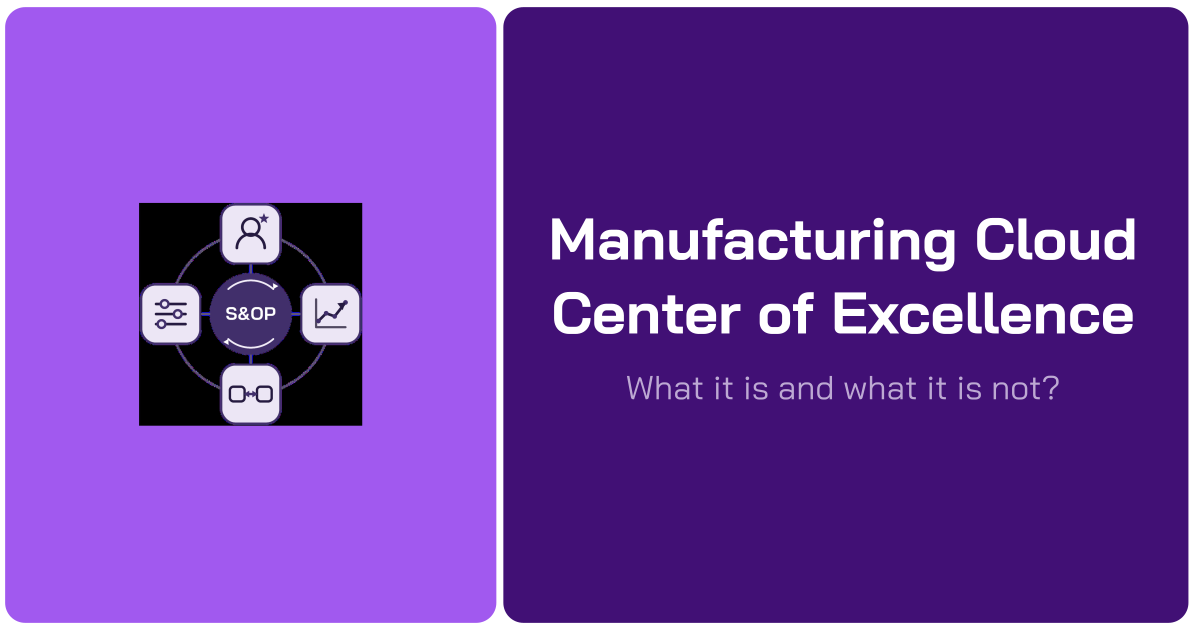
A Manufacturing Cloud Center of Excellence (CoE) is the standing team that owns the platform's operational health, drives continuous improvement, and keeps it aligned to your S&OP process after go-live. In most mid-market manufacturers it takes just two to four people in dedicated or partial roles — what it really requires is the decision to treat Salesforce Manufacturing Cloud as a platform, not a project.
Key takeaways
- A CoE is a standing capability, not a project team, an IT break-fix function, or a quarterly committee.
- The minimum viable CoE has four roles: Platform Owner, Architect/Admin, Demand Planning Process Lead, and Integration Owner.
- It runs on a fixed cadence: monthly reviews, quarterly release readiness, annual platform health.
- The most commonly missing role is the Integration Owner — and missing it is why actuals quietly stop loading.
- Track four leading indicators monthly and four lagging indicators quarterly, or the CoE is an aspiration rather than a function.
Do you need a Manufacturing Cloud CoE?
If two or more of these are true, your Manufacturing Cloud setup likely needs a formal governance model.
Most Manufacturing Cloud implementations are designed for launch. The team is assembled, the configuration is built, training is delivered, and the system goes live. Then the implementation team disperses, the project budget closes, and the system is handed to a Salesforce admin who was not part of the original project.
Without a deliberate operating model, the system decays. Configuration drifts. Adoption erodes. New business requirements pile up in a backlog nobody owns. The investment starts to look like a one-time cost with diminishing returns.
A Center of Excellence is the antidote. It is not a large team or a major budget line. What it requires is organizational intent: a structured decision about who owns the system, what capabilities that team needs, and how they connect the technology to the business process it supports.
The case for a CoE
A platform compounds. A project decays.
Without an operating model, adoption peaks on launch momentum and erodes as configuration drifts and the backlog goes unowned. A Center of Excellence turns the go-live into value that compounds year over year.
What a Manufacturing Cloud Center of Excellence is (and isn't)
A Manufacturing Cloud CoE is the organizational function that owns the platform's operational health, continuous improvement, and alignment with the evolving S&OP process. It pairs technical competence with business competence and stays connected to the people who own the planning process.
It is not:
- An IT support function that handles break-fix tickets.
- A project team that gets stood up for implementations and then disbands.
- A governance committee that meets quarterly to approve changes.
It is a standing capability responsible for ensuring the system keeps serving the business as requirements evolve. That distinction — capability, not project — is what separates implementations that compound value from those that decay after go-live.
What roles does a Manufacturing Cloud CoE need?
The minimum viable Manufacturing Cloud CoE has four roles. In smaller organizations, one person may cover several. In larger ones, each may be a full-time position or a small team.
| Role | Function | Lives in |
|---|---|---|
| Platform Owner | Owns business value and prioritization | Business (Sales Ops / Demand Planning leadership) |
| Manufacturing Cloud Architect / Admin | Technical backbone of the platform | Salesforce / IT |
| Demand Planning Process Lead | Bridge between S&OP process and configuration | Demand Planning |
| Integration Owner | Owns ERP and system integrations | IT |
Platform Owner (business)
The Platform Owner is a senior business stakeholder — typically VP of Sales Operations or VP of Demand Planning — who owns the system's business value and advocates for it internally. This is not a technical role.
They prioritize the enhancement backlog by business impact, resolve cross-functional disputes about process design, protect the system budget, and act as the executive voice for Manufacturing Cloud in the S&OP process. They do not need to know how to configure Salesforce. They need to know the S&OP process deeply and hold the authority to drive change.
Without a Platform Owner at this level, the CoE drifts toward an IT support function and loses the business alignment that drives adoption.
Manufacturing Cloud Architect / Admin
The technical backbone of the CoE — typically a Salesforce admin with Manufacturing Cloud-specific training and experience, ideally someone who worked on the original implementation.
They handle configuration changes, new feature enablement, data quality monitoring, integration health checks, user support escalation, and Salesforce release updates that affect Manufacturing Cloud. The role demands ongoing skill development: Salesforce ships three releases a year with frequent Manufacturing Cloud additions, so an admin who isn't tracking release notes will miss important features and fail to apply critical updates.
Demand Planning Process Lead
A demand planning team member who bridges the S&OP process and the Manufacturing Cloud configuration. They don't need to be a developer, but they need to understand both the forecasting process and the system well enough to recognize when a process problem is actually a configuration requirement.
They run the monthly system review alongside the S&OP cycle, surface process-driven enhancement needs, gather user feedback from the planning team, and serve as the first point of contact for process questions from new users.
Integration Owner
Owns the ERP and system integrations that feed Manufacturing Cloud. This may be an IT resource rather than a dedicated team member, but the accountability has to be formal.
They monitor integration runs and failure rates, manage the exception queue for failed actuals loads, coordinate ERP changes that could break mappings, and own the testing protocol when ERP updates occur.
The Integration Owner is the most commonly missing piece of a Manufacturing Cloud CoE. The ERP integration works at go-live and is then treated as a background service. It isn't one. ERP upgrades, data model changes, fiscal calendar adjustments, and new ERP modules all create maintenance events that — left unmanaged — cause actuals loading failures that can persist for months before anyone notices.
The most missing role
One unowned mapping, and the actuals quietly stop.
The integration works on day one — then an upstream change breaks the field mapping. With no one watching the exception queue, actuals stop loading and forecasts run on stale data for months before anyone notices. Owning that queue is the Integration Owner's whole job.
How should a Manufacturing Cloud CoE govern decisions?
A functional CoE needs a governance model that defines how decisions are made and at what cadence the team operates. Without it, decisions get made ad hoc and at the wrong level — technical calls escalated to executives, business calls made by admins.
Decision rights matrix
| Decision type | Who decides | Who is consulted | Cadence |
|---|---|---|---|
| S&OP process change requiring reconfiguration | Platform Owner | Demand Planning Lead, Admin | As needed (formal change request) |
| New custom field or object | Admin (technical) + Platform Owner (business) | Affected users | Monthly backlog review |
| ERP integration change | Integration Owner | Admin, ERP team | Change management process |
| Permission set / access change | Admin | Platform Owner if organizational | As needed |
| New Salesforce release feature adoption | Admin recommends, Platform Owner approves | Demand Planning Lead | Pre-release review (3x/year) |
| New user onboarding | Demand Planning Lead (process) + Admin (access) | Manager of new user | As needed |
Operating cadence
A functioning CoE runs on a regular rhythm:
- Monthly — Post-S&OP review. Within a week of the monthly S&OP meeting, the Demand Planning Lead and Admin review system performance: were actuals loaded on time, what was the adoption rate, what issues surfaced. A short issues log is maintained.
- Monthly — Enhancement backlog review. The Platform Owner reviews enhancement requests, prioritizes by business impact, and approves items for the next sprint.
- Quarterly — Release readiness review. The Admin reviews upcoming Salesforce release notes for Manufacturing Cloud changes, assesses impact, and recommends which features to adopt. The Platform Owner approves or defers.
- Annually — Platform health review. A full review of the implementation against current S&OP requirements, surfacing accumulated gaps, configuration debt, and integration updates required.
How do you build the enhancement pipeline?
One of the CoE's most valuable functions is managing a structured pipeline of platform improvements. Without it, enhancements accumulate informally — in email threads, Slack messages, and verbal requests at S&OP meetings — and nothing gets prioritized or delivered.
How a CoE should turn requests into governed improvements
Instead of routing every request directly to admins, the CoE should score each request by business impact and technical effort before deciding what moves next.
Intake process
Any user can submit an enhancement request. The intake form captures four things:
- Business problem — what workflow or process is broken or inefficient?
- Proposed solution — what change would address it? (Users propose; the Admin validates feasibility.)
- Estimated impact — how many users are affected, how often, and what is the improvement?
- Priority — is this blocking work, improving efficiency, or nice-to-have?
Prioritization framework
Requests are scored on two dimensions: business impact (how much value would this deliver?) and implementation effort (how much work is required?).
Score it before you build it
Two questions decide where an enhancement goes.
Try a real one:
- High impact, low effort — quick wins, prioritized for early delivery.
- High impact, high effort — go to the quarterly roadmap.
- Low impact — deferred or declined.
The Platform Owner makes the final call, not the Admin. That keeps the pipeline aligned to business value rather than technical preference.
How do you scale Manufacturing Cloud beyond a pilot?
Many Manufacturing Cloud implementations start as a pilot — a single region, product line, or country. The CoE is what makes the jump from pilot to enterprise repeatable instead of risky.
Document what the pilot taught you
Before expanding scope, the CoE should produce a lessons-learned document: which configuration decisions worked, what needed changing, what process design users accepted, and what caused friction. This becomes the design input for the expansion — so the larger rollout doesn't repeat the pilot's mistakes.
Package configuration templates
Core components from the pilot — Forecast Set structure, page layouts, Flow automations, validation rules, permission sets — should be documented and packaged as deployment templates. This cuts the time and risk of each subsequent rollout and keeps configuration consistent across regions.
Build a repeatable onboarding program
A scalable onboarding program is a CoE deliverable, not a one-time project output. It should include:
- Role-based training — not a generic here is Manufacturing Cloud tour, but here is exactly what you do in the system for your role in the S&OP process.
- A hands-on practice environment with realistic sample data.
- A certification or sign-off that confirms readiness before granting production access.
- An ongoing support channel where users get answers within 24 hours.
How does a Manufacturing Cloud CoE actually do the work?
A CoE can have every role staffed and every review on the calendar and still stall — because the daily work has nowhere good to happen.
Reviewing forecasts, checking which actuals didn't load, adjusting a few hundred Account Forecast Periods, working down the enhancement backlog: in most orgs that work is scattered across reports, list views, and exported spreadsheets, handled one record at a time. That's not a minor annoyance — it's why the first metric in the next section, user engagement, is also the first to slip. When adjusting a forecast means opening records one by one, or exporting to Excel and breaking the link to Salesforce, demand planners quietly stop. The operating model says "review and adjust monthly"; the interface makes it a chore, so it doesn't happen. Forecast updates that should take minutes end up taking days.

The answer is to give the CoE one surface to do the work, inside Salesforce. A spreadsheet-style grid like Valorx Wave lets planners review and adjust Account Forecast Periods in bulk, surface missing or late actuals with conditional formatting, and push operational changes across hundreds of records in a single action — no exports, no leaving the platform, and with Salesforce security and sharing rules fully enforced. The governance you designed stays enforceable because the work never leaves the system of record — and the integration stays honest, because when ERP actuals land the team can see and clear the exception queue in the same place they do everything else.
How do you measure CoE effectiveness?
Run it like a function
What a healthy quarter looks like.
Actuals load success
≥95% within 5 days of close
User engagement
Planners adjusting AFPs
S&OP data timeliness
Ready before the review
Enhancement delivery
Shipped on committed date
Forecast accuracy (MAPE)
Trending down ✓
Finance adoption
Not a parallel model
S&OP meeting quality
Not reading data aloud
Backlog health
Shrinking, not growing
in range — an illustrative healthy quarter. The leading four warn you monthly; the lagging four confirm the trend held. A dot drops out of range the moment a number does — which is the whole point of watching them.
A CoE without metrics is an aspiration, not a function. Track these leading and lagging indicators.
Leading indicators (monthly)
- Actuals load success rate — what percentage of Account Forecast Periods had actuals loaded within 5 business days of month-close?
- User engagement rate — what percentage of active demand planners made at least one Account Forecast Period adjustment in the prior planning cycle?
- S&OP data timeliness — was the demand plan data in Salesforce available before the demand review meeting?
- Enhancement delivery rate — what percentage of approved enhancements shipped on the committed timeline?
Adoption note: User engagement rate is often the first metric to slip, and the cause is usually friction — planners avoid the system when adjusting forecasts record-by-record is slow. A spreadsheet-style editing layer like Valorx Wave lets planners review and adjust Account Forecast Periods in bulk inside Salesforce, which is one practical way to keep engagement high without pulling data into offline spreadsheets. NVIDIA took a similar approach to demand forecasting and saw high adoption with minimal disruption to existing workflows.
Lagging indicators (quarterly)
- Forecast accuracy trend — is MAPE improving, stable, or degrading quarter over quarter?
- Finance adoption — is Finance using Salesforce data as its primary source, or running a parallel model?
- S&OP meeting quality — has the meeting shifted from reading data aloud to deciding from a pre-read dashboard? (Qualitative, assessed by the Platform Owner.)
- Backlog health — is the enhancement backlog growing faster than it is resolved? A growing backlog signals under-resourcing or misaligned prioritization.\
Self-assessment · 30 seconds
Is your Manufacturing Cloud a platform or a project?
Six quick questions about how your CoE runs today. You'll get a readiness score and the gaps to close first.
Want help closing these gaps?
Book a Manufacturing Cloud demoA platform, not a project
A Manufacturing Cloud Center of Excellence is a small investment relative to the implementation itself. In most mid-market manufacturers, two to four people with defined roles and a governance cadence is enough. What it requires is organizational commitment — the decision that Manufacturing Cloud is a platform that needs an operating model to match.
The implementations that deliver sustained value are almost always the ones that built this operating model deliberately, not the ones that hoped go-live momentum would carry them forward indefinitely.
Planning a Manufacturing Cloud rollout — or trying to drive adoption on one you already have? Book a demo to see how Valorx Wave helps demand planners work with forecast data at spreadsheet speed, without leaving Salesforce.
Frequently asked questions
What is a Manufacturing Cloud Center of Excellence?
A Manufacturing Cloud Center of Excellence (CoE) is the standing team that owns a Salesforce Manufacturing Cloud platform's operational health, continuous improvement, and alignment with the S&OP process after go-live. It pairs technical and business expertise and is responsible for keeping the system serving the business as requirements evolve.
How many people do you need for a Manufacturing Cloud CoE?
Most mid-market manufacturers need two to four people in dedicated or partial roles. In smaller organizations one person can cover multiple roles; in larger ones each role can be a full-time position or a small team.
What roles are in a Salesforce Manufacturing Cloud CoE?
The four core roles are the Platform Owner (a senior business stakeholder who owns value and prioritization), the Manufacturing Cloud Architect/Admin (the technical backbone), the Demand Planning Process Lead (the bridge between S&OP and configuration), and the Integration Owner (who owns ERP and system integrations).
How is a CoE different from IT support?
IT support handles break-fix tickets reactively. A CoE is a standing capability with business ownership that drives continuous improvement, prioritizes enhancements by business impact, and keeps the platform aligned to the evolving S&OP process. A CoE without a senior business Platform Owner tends to collapse into an IT support function and lose adoption.
How often should a Manufacturing Cloud CoE meet?
A functioning CoE runs monthly post-S&OP reviews and enhancement backlog reviews, a quarterly Salesforce release readiness review (three times a year, aligned to Salesforce's release cadence), and an annual platform health review.
What metrics measure Manufacturing Cloud CoE success?
Track four leading indicators monthly — actuals load success rate, user engagement rate, S&OP data timeliness, and enhancement delivery rate — and four lagging indicators quarterly — forecast accuracy (MAPE) trend, Finance adoption, S&OP meeting quality, and enhancement backlog health.
Do you need a CoE for a small Manufacturing Cloud deployment?
Yes. The CoE scales down to a single person covering multiple roles, but the roles and governance cadence still need to be assigned explicitly. The most common failure in small deployments is leaving the Integration Owner role unassigned, which leads to actuals loading failures that go unnoticed for months.
What does a Manufacturing Cloud CoE do?
Owns platform health after go-live: governance cadence, enhancement pipeline, user support, and keeping the system aligned to the S&OP process as the business changes.
How big does the team need to be?
In most mid-market manufacturers, two to four people in dedicated or partial roles — the decision to treat the platform as a product matters more than headcount.
What metrics should a CoE track?
Forecast accuracy trend, submission rates, in-system edit share, enhancement throughput, and cycle-time of the monthly forecast process.
Choose the workflow you need:
Try Wave in browser Extension

Try Wave in Salesforce

Try Fusion In Excel

Enhancing Salesforce for industry leaders