4 Ways Managing Salesforce Data Offline Hurts Your Business

Quick answer: Managing Salesforce data offline in spreadsheets hurts a business four ways: records go stale immediately, edits get lost between copies, sensitive data escapes CRM security controls, and the org loses its single source of truth. Each risk — and how live spreadsheet connections eliminate the reason to export — is below.
Strategic business decisions are built on accurate, accessible data. Yet many businesses struggle to maintain a single source of truth due to an internal over-reliance on offline spreadsheets for managing Salesforce records. Instead, they incur the hidden costs of incomplete, out-of-date, data.
Data silos and offline data management is an outdated, error-prone, high-risk practice that inhibits growth. The negative impact on the business may not be felt immediately, but over time leads to lack of Salesforce user adoption and revenue leakage.
This article looks at four major ways that businesses suffer when offline Salesforce data management remains common practice. We also look at how businesses can unify their offline and online processes, with minimal change management, to eliminate the inefficiencies and costs they currently deal with.
Costs of Offline Salesforce Data Management
1. Data Inaccuracies and Errors - Risks to Business Strategy
Offline spreadsheets are the kryptonite to accurate, reliable data. Different versions of records, duplicate data, a lack of transparency, and a lack of accessibility make it impossible for informed planning.
Businesses rely on skewed historical data to plan for the future, or are unable to quickly adapt to changes in demand. Data errors can lead to disruptions in operations or having businesses focusing on the wrong things. As a result, businesses over or under produce products, miss out on sales opportunities, and risk straining their relationships with existing customers.
2. Lost Time on Manual Processes, Less Time for Growth Activities
When data is managed offline in spreadsheets, teams often face delays due to outdated information, leading to constant manual updating and reconciliation with Salesforce records. This disconnected process pulls attention away from strategic initiatives, as teams spend excessive time ensuring data accuracy across systems - ultimately leading to wasted hours and potentially outdated information in Salesforce.
Some of these impacts include:
- Executive distraction: Senior leaders are often drawn into resolving data issues, detracting their focus from core growth strategies.
- High-cost labor on repetitive tasks: Skilled teams that could drive growth end up spending valuable hours reconciling data.
This inefficient time allocation directly affects scalability and agility, as manual data handling in spreadsheets becomes increasingly unsustainable with growth.
For data management to support strategic decision-making, businesses need real-time data access - something that spreadsheets alone cannot provide.
3. Financial Risks Due to Stale Data and Limited Insights
With gaps in data, there is a high risk of over-or-under producing which leads to increased operating costs. A healthy business also relies on the ability to respond to new data and information quickly, which cannot be achieved when data lives fragmented across spreadsheets.
- Increased expenses: Revenue shortfall from overproduction, costs of storing products, and failing to meet customer needs hurt the business
- Missed strategic opportunities: Slow to respond to new data points and business opportunities. This inhibits growth and grants competitors an advantage.
- Inability to pivot: Spreadsheet-driven workflows slow your ability to respond to market changes, limiting agility.
The financial impact of relying on outdated data compounds over time, resulting in missed revenue and limiting your organization’s ability to respond to new growth opportunities.
4. As The Business Grows, Scalability Challenges Increase
As your organization expands, data complexity and volume grow exponentially. Offline spreadsheets will not allow your business to keep pace.
- Operational bottlenecks: Large data volumes overwhelm spreadsheet workflows, slowing processes and creating backlogs.
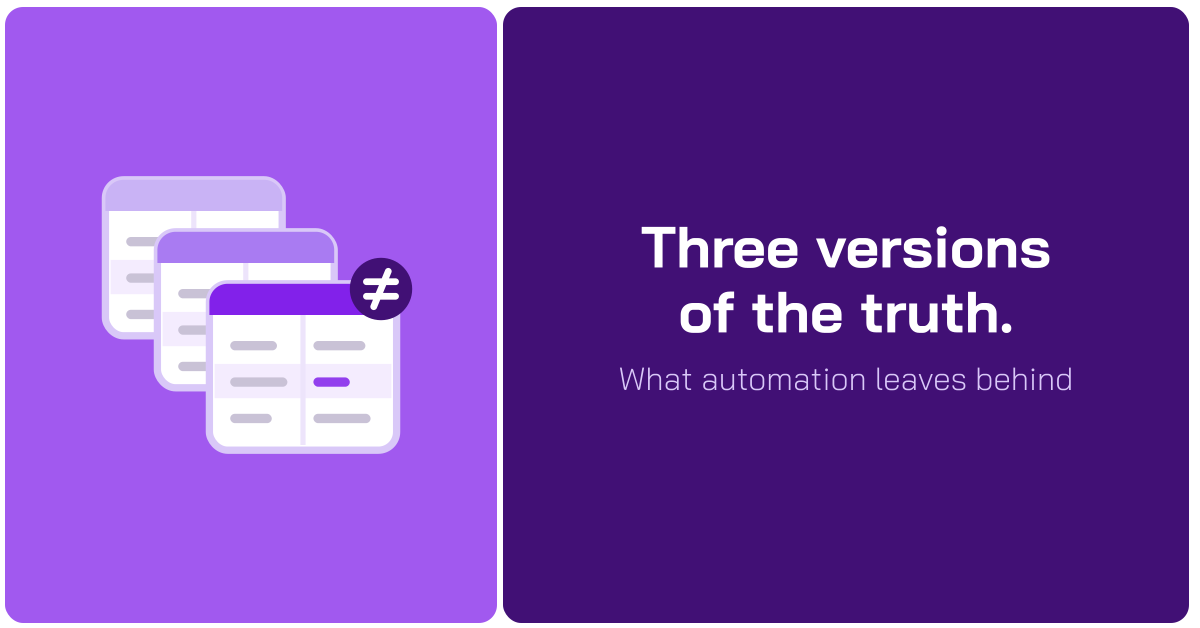
- Version control breakdowns: As more people touch the data, conflicting versions emerge, leading to costly delays and inefficiencies.
- Inadequate support for modern operations: Spreadsheets lack the automation and integration needed to keep pace with the scale and complexity of growing businesses, creating vulnerabilities as processes multiply.
Upgrading Your Salesforce Forecasting Experience
Spreadsheets aren’t just holding your business back - they’re costing you money in lost productivity, missed revenue, and poor decision-making. As your business grows, these hidden costs multiply, dragging down profitability and operational efficiency.
The solution is not to abandon spreadsheets entirely but to harness their familiarity while enhancing them with live Salesforce data.
Valorx Fusion offers a high-ROI solution by merging the flexibility of spreadsheets with Salesforce’s full capabilities, transforming data management and empowering teams to make smarter, faster decisions.
The results are immediate and measurable:
- Live data access: Teams work with live Salesforce data directly from their spreadsheets, eliminating costly delays and inaccuracies.
- Operational efficiency: By automating manual processes, Fusion enables teams to focus on growth-driving initiatives, not low-value data tasks.
- Scalability: Fusion seamlessly scales with your business, removing operational bottlenecks and supporting complex workflows.
Valorx Fusion is a strategic investment for accelerating growth and improving efficiency, with returns that are immediate and measurable.
Book a demo of Valorx Fusion today to experience a new level of efficiency in Salesforce data management, capture new revenue opportunities, and future-proof your operations for growth.
Frequently asked questions
How do offline spreadsheets impact Salesforce user adoption?
When users cannot trust the data in Salesforce—or find it easier to work in spreadsheets—they gradually stop using Salesforce as the single source of truth. This weakens adoption and reduces ROI from your CRM investment.
What happens when a business scales with spreadsheet-based processes?
As data volume grows, spreadsheets become harder to manage. This leads to:
- Version control issues
- Increased errors
- Process bottlenecks
- Reduced agility and scalability
Can spreadsheets and Salesforce work together effectively?
Yes—but only when they are connected. The goal is not to eliminate spreadsheets, but to integrate them with live Salesforce data so teams can work in a familiar interface without compromising data accuracy.
Who should consider moving away from offline Salesforce data management?
Any organization that:
- Relies heavily on spreadsheets for Salesforce data
- Experiences data inconsistencies
- Struggles with reporting accuracy
- Is scaling operations or data volume
How does Valorx Fusion reduce manual work?
Valorx Fusion automates data syncing between spreadsheets and Salesforce, eliminating the need for:
- Manual imports and exports
- Repetitive data reconciliation
- Duplicate data entry
This allows teams to focus on higher-value, strategic tasks.
What kind of ROI can businesses expect from integrating spreadsheets with Salesforce?
Businesses typically see ROI through:
- Time savings from automation
- Improved data accuracy
- Increased Salesforce adoption
- Better forecasting and revenue capture
Why do teams manage CRM data offline?
Speed and familiarity: Salesforce's native UI is slow for bulk work, and Excel is not — so users export despite the risks.
What's the security exposure?
Exported files bypass profiles, sharing rules, and audit trails entirely — customer data on laptops and email is the classic breach path.
What's the alternative to exporting?
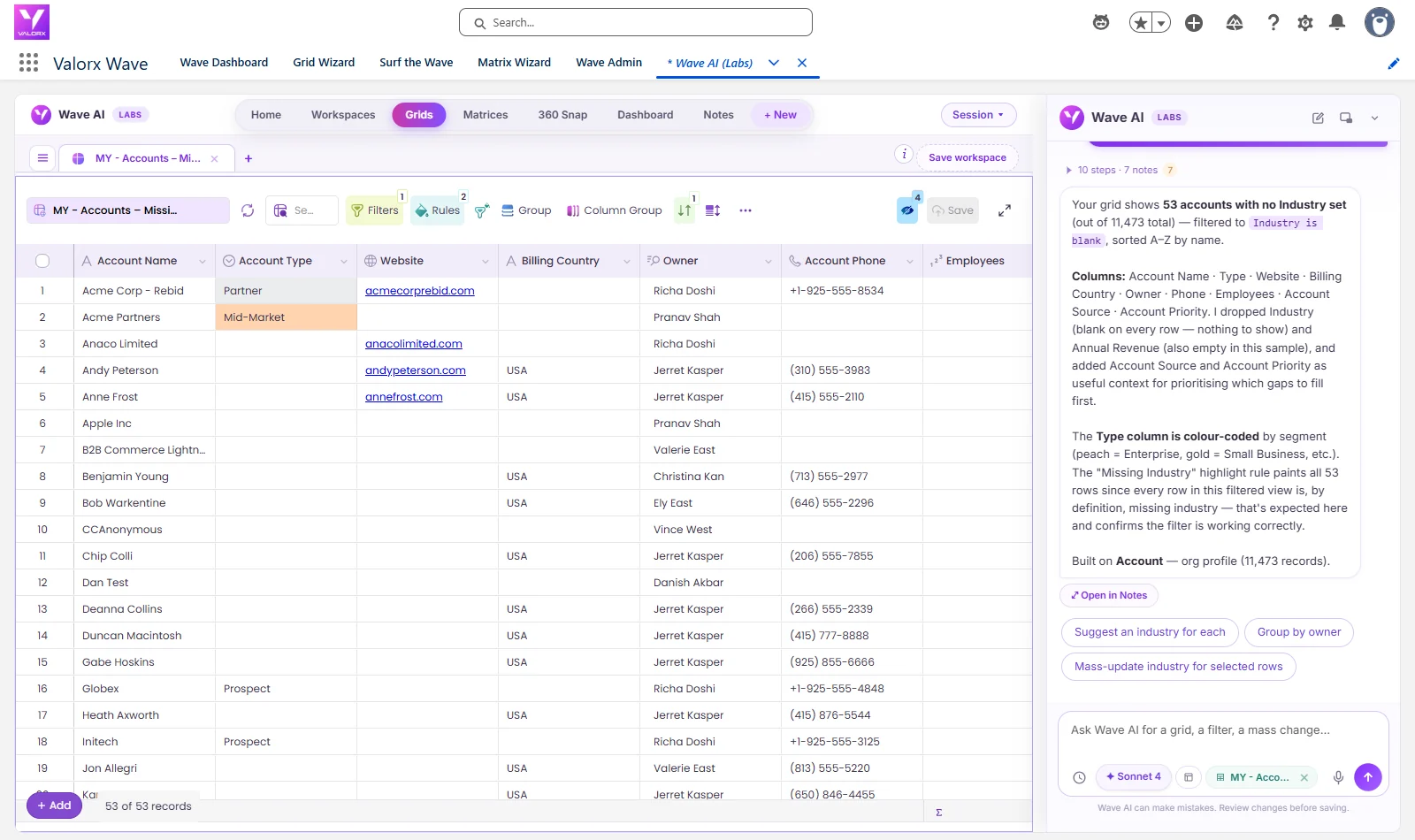
Spreadsheet interfaces on live data (Valorx Wave in-browser, Fusion in Excel/Sheets) — same speed, zero offline copies.

.svg)

.png)


Choose the workflow you need:
Try Wave in browser Extension

Try Wave in Salesforce

Try Fusion In Excel

Enhancing Salesforce for industry leaders